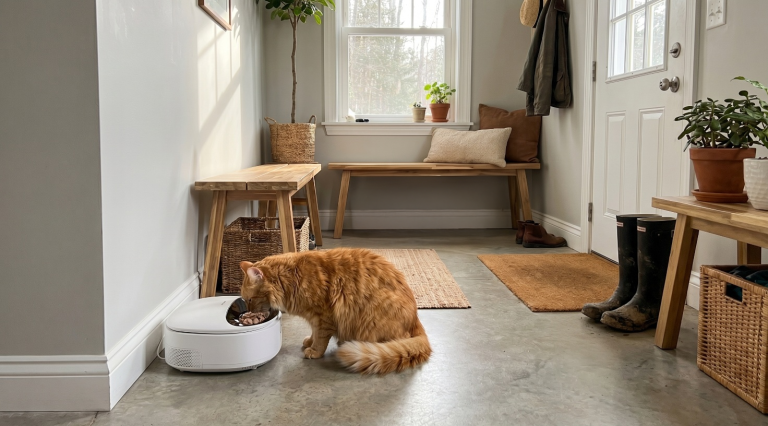
Timer Cat Feeder vs Smart Cat Feeder 2026: Which One Does Your Cat Actually Need?
Timer Cat Feeder vs Smart Cat Feeder 2026: Which One Does Your Cat Actually Need?
Introduction
The difference between a timer feeder and a smart feeder comes down to one question: do you need to control feeding from your phone, or is a set-it-and-forget-it schedule enough?
Timer feeders (also called programmable feeders) let you set meal times and portions using physical buttons on the device. They run on batteries and require no internet connection. Smart feeders connect to WiFi, sync with a phone app, and offer remote control, notifications, and feeding history. They cost two to three times more.
Neither is universally better. The right choice depends on your schedule, your cat’s needs, and how much control you actually want.
Comparison Table
| Feature | Timer Feeder | Smart Feeder |
|---|---|---|
| Price Range | $25-60 | $60-150 |
| Setup | Physical buttons, 5 min | App download, WiFi setup, 15 min |
| Remote Control | None | Full control from phone |
| Meal Scheduling | Up to 6 meals | Up to 10+ meals |
| Portion Precision | Fixed increments | Customizable (gram-level) |
| Notifications | None | Low food, low battery, feeding alerts |
| Feeding History | None | App tracks every meal |
| WiFi Dependency | None | Required for smart features |
| Battery Backup | Common (AA/C/D) | Limited (some models) |
| App Reliability | N/A | Varies by brand |
| Multi-Cat Support | Manual portion only | RFID/microchip options |
| Typical Lifespan | 3-5 years | 2-4 years |
| Moving / Travel | Simple, pack and go | Re-setup at each location |
What a Timer Feeder Does Well
Reliability
Timer feeders are simple machines. They have fewer parts and less that can break. No WiFi module, no app update that breaks functionality, no cloud server that goes down. You set the time and portions using the physical interface, and the feeder runs the same schedule every day, year after year.
Battery Life
Because they lack WiFi radios (which draw power), timer feeders run significantly longer on batteries. Most run 3-6 months on a set of batteries. Smart feeders with WiFi active typically need battery changes every 2-4 weeks — or must stay plugged in.
Simplicity
Anyone can operate a timer feeder. Physical buttons and a small LCD screen are straightforward. There is no learning curve, no account creation, no app permissions to grant.
Portability
Timer feeders travel better. You can pack one for a weekend trip, set the schedule, and it works. Smart feeders require WiFi reconfiguration at each new location, which is impractical for frequent travel.
Price
Timer feeders cost $25-60. That is one-third to one-half the price of a comparable smart feeder. For owners on a budget, a timer feeder provides perfectly adequate automatic feeding.
Where Timer Feeders Fall Short
No Remote Control
You cannot check if the feeder dispensed lunch while you are at work. You cannot adjust dinner portions from the airport. If your plans change while away from home, the timer feeder follows the schedule you set yesterday.
No Notifications
A timer feeder will run out of food without telling you. A power outage resets the clock, and the feeder dispenses at the wrong time until you notice. There is no low-battery warning.
Limited Portion Flexibility
Most timer feeders offer fixed portion sizes (1/4 cup, 1/2 cup, etc.) rather than gram-level precision. For cats on strict dietary plans, this lack of granularity is a genuine limitation.
No Feeding History
If your veterinarian asks how much your cat ate over the past week, a timer feeder cannot answer. You would need to track manually.
What a Smart Feeder Does Well
Remote Feeding Control
The main advantage of a smart feeder is controlling it from anywhere. You can dispense an extra meal from your phone, check if the cat already ate, or adjust tomorrow’s schedule while traveling. This is genuinely useful for owners with irregular schedules.
Notifications
Smart feeders push alerts when food is low, batteries need replacing, or the feeder has a jam. The best ones also notify you when your cat eats — useful for monitoring appetite changes in cats with health conditions.
Meal History
Every meal is logged: time, portion size, and whether the cat ate. This data helps track eating patterns, identify appetite loss early, and provide accurate information to your vet.
Multi-Cat Support
Higher-end smart feeders (SureFeed Microchip, PETLIBRO Granary) use RFID or microchip recognition to allow only specific cats access. Timer feeders cannot differentiate between cats.
Portion Precision
Smart feeders typically allow gram-level portion settings, which is important for cats on prescription diets or weight management plans. The difference between 15g and 18g per meal matters for a cat on a strict feeding protocol.
Where Smart Feeders Fall Short
WiFi Dependency
A smart feeder without WiFi is a dumb feeder that costs too much. If your internet goes down, you lose remote control and notifications. Most smart feeders continue to follow their programmed schedule offline, but you cannot change it until the connection is restored.
App Reliability
Smart feeder apps vary wildly in quality. PETLIBRO’s app is generally rated well. PETKIT’s app has more mixed reviews. Some brands abandon app updates after a year, leaving users with buggy software. An app update can also change the interface, remove features, or introduce new bugs.
Higher Price
Smart feeders cost $60-150, two to three times more than timer feeders. You are paying for the WiFi module, the app development, and the cloud infrastructure. For owners who do not need remote access, this is money spent on unused features.
Shorter Lifespan
Smart feeders have more components that can fail: WiFi modules, app servers, cloud APIs. When the manufacturer stops supporting the app, the smart features stop working. Timer feeders, with no connectivity dependence, continue working indefinitely.
Setup Complexity
Setting up a smart feeder requires app installation, account creation, WiFi configuration, and firmware updates. The average setup takes 10-20 minutes. Timer feeders take 2-5 minutes.
Decision Guide: Which One Should You Buy?
Buy a Timer Feeder If:
- You want reliable feeding without phone notifications
- Your schedule is predictable (same meal times every day)
- You travel frequently and need the feeder to work in different locations
- You are on a tight budget ($25-60)
- You prefer simple, physical controls over app-based interfaces
- You want a feeder that lasts 5+ years
- Your cat does not need special diet differentiation
Buy a Smart Feeder If:
- You want to monitor and adjust feeding from your phone
- Your schedule is irregular and you change meal times frequently
- You want notifications for low food, jams, or missed meals
- Your cat needs gram-level portion precision for weight management
- You own multiple pets and need RFID/microchip access control
- You want feeding history data for veterinary visits
- You are comfortable with app-based technology and occasional connectivity issues
Buy Both If:
- You have multiple cats with different dietary needs — use a smart microchip feeder for the cat on special food and a timer feeder for the others
- You want a smart feeder for daily use and a backup timer feeder for travel
- You are transitioning from timer to smart — keep the timer as a spare
Recommended Models
Best Timer Feeders
| Model | Price | Max Meals | Battery | Capacity | Best For |
|---|---|---|---|---|---|
| Cat Mate C5000 | $45-55 | 4 | D (6mo) | 5 meals | Wet food, reliability |
| WOPET Timer | $25-35 | 6 | AA (3mo) | 2L | Budget pick |
| Catit Pixi | $30-40 | 6 | AA (3mo) | 2L | Simplicity |
| Homdox Timer | $25-30 | 4 | AA (2mo) | 1.5L | Ultra-budget |
Best Smart Feeders
| Model | Price | Max Meals | App Rating | Best For |
|---|---|---|---|---|
| PETLIBRO DockStream | $80-100 | 10 | 4.3/5 | Best overall smart feeder |
| SureFeed Microchip | $150-170 | Unlimited | 4.5/5 | Multi-cat access control |
| PETKIT Fresh Element | $60-80 | 10 | 3.8/5 | Budget smart option |
| WOPET Smart | $50-70 | 6 | 3.9/5 | Value smart feeder |
FAQ
Can a timer feeder work without batteries?
No. All timer feeders require batteries. Most run 2-6 months on a single set. The lack of power cord is what makes them portable.
Can I use a smart feeder without WiFi?
Yes, but you lose app control, notifications, and feeding history. The feeder continues to follow its programmed schedule offline. Some smart feeders require WiFi for initial setup.
Do smart feeders work internationally?
Smart feeders need 110-240V compatible power adapters and WiFi that operates on your region’s frequencies (2.4GHz is standard globally). Apps must be available in your country’s app store.
Which type is more reliable?
Timer feeders are more reliable because they have fewer failure points. No WiFi module, no app dependency, no cloud API. For critical feeding reliability, choose a timer feeder.
Can I control a timer feeder with a smart plug?
No. A smart plug turns the feeder on and off, but timer feeders dispense based on their internal clock, not power. A smart plug cannot trigger a meal.
Do vets recommend timer or smart feeders?
Vets typically recommend whichever feeder ensures consistent feeding. For healthy cats on a stable diet, either works. For cats with medical conditions (diabetes, kidney disease), the feeding history and portion precision of a smart feeder are valuable.
Final Verdict
For most cat owners, a timer feeder is the practical choice. It is reliable, affordable, and does everything an automatic feeder needs to do: feed your cat on schedule.
Upgrade to a smart feeder if you genuinely need remote access, notifications, or multi-cat microchip control. The added cost and complexity are justified only when you use those features.