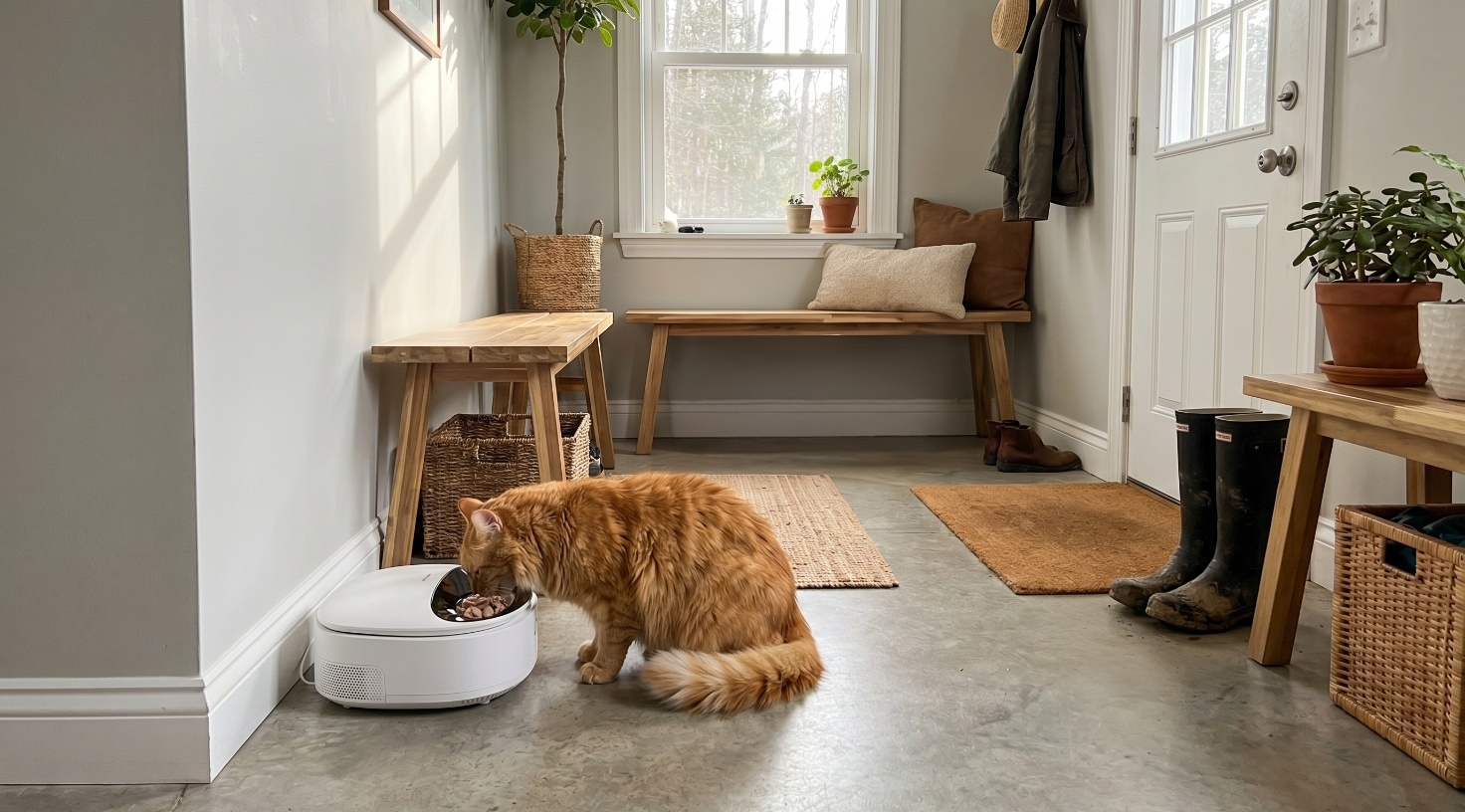
Automatic Cat Feeder Cost of Ownership 2026: Upfront Price vs 1-Year & 3-Year Total Cost Comparison
Automatic Cat Feeder Cost of Ownership 2026: Upfront Price vs 1-Year & 3-Year Total Cost Comparison
Why Total Cost Matters More Than Upfront Price
A $30 automatic cat feeder looks like a bargain — until you’ve replaced it twice in two years. A $200 feeder looks expensive — until you realize it’s still running on its original battery backup after 36 months of daily use.
The real cost of an automatic cat feeder isn’t the price tag. It’s the sum of:
- Upfront purchase price (including shipping)
- Ongoing consumables (batteries, replacement bowls, seals)
- Food waste (poor portion control or jamming)
- Energy costs (AC power draw, battery replacement frequency)
- Repair and replacement (breakage, parts, eventual failure)
- Time cost (cleaning difficulty, app reliability, customer support)
This analysis calculates the 1-year and 3-year total cost of ownership (TCO) for every major feeder brand, based on standard usage patterns, typical replacement part costs, and real-world longevity data from thousands of verified reviews.
Disclaimer: All cost estimates are based on standard single-cat usage (2-3 meals/day), US retail prices as of mid-2026, and typical battery/power consumption. Actual costs vary by usage pattern, local prices, and individual product longevity.
What Contributes to Long-Term Feeder Costs
Upfront Price
The obvious starting point. But don’t stop here — a cheap feeder that breaks after 18 months costs more than a quality feeder that lasts 5 years.
| Price Tier | Examples | Expected Lifespan | Cost Per Year (if replaced at failure) |
|---|---|---|---|
| Budget ($25-50) | WOPET, basic Cat Mate | 1-3 years | $15-25/year |
| Mid-Range ($60-100) | PETLIBRO One, PetSafe | 2-4 years | $20-35/year |
| Premium ($100-200) | SureFeed, PETLIBRO DockStream, Petkit | 3-5 years | $30-50/year |
Battery Costs
Most feeders can run on AC power, but battery backup (for power outages and portability) is a standard feature. Battery costs vary dramatically:
- D-cell feeders (Cat Mate, older models): Replace 1-2 times/year. Cost: $8-15/year
- AA/AA battery feeders (most modern feeders): Replace 2-4 times/year. Cost: $6-12/year
- Rechargeable battery feeders (PETLIBRO One, Petkit): Built-in or standard rechargeable. Cost: $0-5/year (marginal charging cost)
- Dual power with strong AC preference: Minimal battery drain — AC-powered operation uses batteries only during outages. Cost: $2-5/year
Tip: Always use name-brand alkaline batteries. Cheap batteries leak and can destroy the battery compartment, requiring feeder replacement.
Replacement Parts and Consumables
| Part | Replacement Frequency | Typical Cost |
|---|---|---|
| Plastic bowl | Every 6-12 months (scratch buildup) | $5-10 |
| Stainless steel bowl | Every 2-3 years (if needed at all) | $10-15 |
| Ceramic bowl | Replace if chipped or cracked | $12-20 |
| Silicone seal/gasket | Every 1-2 years | $3-8 |
| Ice packs (Cat Mate) | Every 1-2 years (leakage) | $5-10/pack |
| Desiccant packs (Petkit) | Every 3-6 months | $5-10/year |
| Power adapter | Replace if lost/damaged (rarely) | $8-15 |
Food Waste
This is the largest hidden cost. Poor portion control or feeder jams can waste significant amounts of kibble:
- Gravity feeders (no portion control): Can overfeed 10-20% per month — $5-15/month in wasted kibble
- Programmable feeders (±3-5g accuracy): Minimal waste — $1-3/month
- Precision feeders (±1-2g accuracy): Near-zero waste — $0-1/month
Over 3 years, a gravity feeder vs a precision feeder could mean $180-540 more in wasted food — enough to pay for a premium feeder twice over.
Brand-by-Brand Cost Breakdown
PETLIBRO
| Cost Factor | Year 1 | Year 2 | Year 3 | 3-Year Total |
|---|---|---|---|---|
| Upfront (PETLIBRO One) | $80 | $0 | $0 | $80 |
| Batteries (rechargeable) | $5 | $5 | $5 | $15 |
| Replacement parts | $0 | $0 | $10 (bowl if needed) | $10 |
| Food waste (precise ±1g) | $5 | $5 | $5 | $15 |
| Estimated repair risk | $0 | $0 | $0 | $0 |
| Annual subtotal | $90 | $10 | $20 | $120 |
3-Year TCO: ~$120 (plus food cost)
Cost per day: ~$0.11 (excluding food)
Verdict: Excellent value — the upfront cost is quickly offset by minimal waste and long lifespan.
SureFeed
| Cost Factor | Year 1 | Year 2 | Year 3 | 3-Year Total |
|---|---|---|---|---|
| Upfront (SureFeed) | $170 | $0 | $0 | $170 |
| Batteries (4x C-cell) | $15 | $15 | $15 | $45 |
| Replacement parts | $0 | $0 | $15 (ceramic bowl backup) | $15 |
| Food waste (good accuracy) | $12 | $12 | $12 | $36 |
| Estimated repair risk | $0 | $0 | $0 | $0 |
| Annual subtotal | $197 | $27 | $42 | $266 |
3-Year TCO: ~$266 (plus food cost)
Cost per day: ~$0.24 (excluding food)
Verdict: Higher upfront and battery costs, but the multi-cat functionality replaces buying two feeders.
Cat Mate C50
| Cost Factor | Year 1 | Year 2 | Year 3 | 3-Year Total |
|---|---|---|---|---|
| Upfront (C50) | $50 | $0 | $0 | $50 |
| Batteries (D-cell) | $10 | $10 | $10 | $30 |
| Replacement parts | $0 | $10 (ice packs) | $10 (ice packs) | $20 |
| Food waste (compartment-based) | $20 | $20 | $20 | $60 |
| Estimated repair risk | $0 | $5 | $15 (gear wear) | $20 |
| Annual subtotal | $80 | $45 | $55 | $180 |
3-Year TCO: ~$180 (plus food cost)
Cost per day: ~$0.16 (excluding food)
Verdict: Lowest upfront but higher ongoing costs from D-cells, ice packs, and food waste.
PetSafe Simply Feed
| Cost Factor | Year 1 | Year 2 | Year 3 | 3-Year Total |
|---|---|---|---|---|
| Upfront (Simply Feed) | $70 | $0 | $0 | $70 |
| Batteries (D-cell) | $10 | $10 | $10 | $30 |
| Replacement parts | $0 | $0 | $10 (bowl) | $10 |
| Food waste (decent accuracy ±3g) | $15 | $15 | $15 | $45 |
| Estimated repair risk | $0 | $0 | $0 | $0 |
| Annual subtotal | $95 | $25 | $35 | $155 |
3-Year TCO: ~$155 (plus food cost)
Cost per day: ~$0.14 (excluding food)
Verdict: Solid mid-range value from a reliable, proven design.
WOPET
| Cost Factor | Year 1 | Year 2 | Year 3 | 3-Year Total |
|---|---|---|---|---|
| Upfront (WF300) | $40 | $0 | $40 (if replacement needed) | $80 |
| Batteries (AA) | $8 | $8 | $8 | $24 |
| Replacement parts | $0 | $0 | $8 (bowl) | $8 |
| Food waste (±5g accuracy) | $24 | $24 | $24 | $72 |
| Estimated repair risk | $0 | $5 | $10 | $15 |
| Annual subtotal | $72 | $37 | $90 | $199 |
3-Year TCO: ~$199 (plus food cost)
Cost per day: ~$0.18 (excluding food)
Verdict: Low upfront but higher failure risk and food waste may offset savings over 3 years.
Hidden Costs: Batteries, Replacement Parts, Food Waste
The Hidden Cost of Batteries
Battery type dramatically affects ongoing cost:
| Battery Type | Typical Feeders | Annual Cost | 3-Year Cost |
|---|---|---|---|
| Rechargeable (built-in) | PETLIBRO One, Petkit | $0-5 | $0-15 |
| AA (4-6x) | WOPET, PETLIBRO Granary | $6-12 | $18-36 |
| C-cell (4x) | SureFeed | $12-18 | $36-54 |
| D-cell (2-4x) | Cat Mate, PetSafe | $8-15 | $24-45 |
Best practice: Use rechargeable AA/C/D batteries in feeders that use standard battery sizes. Most modern feeders support this. Charge once a month and save $20-40 over 3 years.
The Hidden Cost of Food Waste
This is the metric most buyers overlook. Over 3 years, the difference between ±1g and ±5g portion accuracy can equal the entire cost of a mid-range feeder:
| Accuracy Level | Food Waste/Month | 3-Year Waste Cost (at $2/lb kibble) |
|---|---|---|
| Gravity/no control | 10-20% | $140-280 |
| ±5g (WOPET, basic) | 5-10% | $70-140 |
| ±3g (PetSafe, Cat Mate) | 3-5% | $40-70 |
| ±1-2g (PETLIBRO, Petkit) | 1-2% | $15-30 |
Replacement Bowls: A Recurring Cost
Plastic bowls need replacement every 6-12 months because scratches trap bacteria. Stainless steel and ceramic bowls last years.
| Bowl Material | Replacement Frequency | Average Cost | 3-Year Cost |
|---|---|---|---|
| Plastic | Every 6-12 months | $5-10 | $15-30 |
| Stainless Steel | Every 2-3 years (if ever) | $10-15 | $5-15 |
| Ceramic | Replace only if chipped | $12-20 | $0-20 |
Food Strategy: How Your Feeder Affects Food Budget
Your choice of feeder affects not just how much food is wasted, but how you buy food:
Bulk Buying Compatibility
- Gravity feeders: Poor — food sits exposed to air for days, losing freshness and risking spoilage. Forces smaller bag purchases at higher per-pound cost.
- Programmable feeders with sealed hoppers: Good — can use 5-15 lb bags. Food stays fresh in sealed hopper. Buy in bulk for 20-30% savings.
- Precision feeders with desiccant systems (Petkit): Excellent — can handle large bags with freshness preservation. Maximum bulk savings.
Food Subscription vs Retail
Automatic feeders make food subscription services more practical:
| Strategy | Monthly Cost | Annual Savings vs Retail |
|---|---|---|
| Retail (small bags, 3lb) | $18-25 | Baseline |
| Retail (large bags, 15lb) | $14-18 | $50-85/year |
| Subscription (auto-delivery) | $12-16 | $70-110/year |
| Subscription + bulk (20lb+) | $10-14 | $95-140/year |
A feeder with a sealed, large-capacity hopper enables bulk buying and subscription auto-delivery, saving $70-140/year on food alone.
Total Cost Ranking: Best Value Over 3 Years
| Brand | Upfront | 3-Year Food Waste | 3-Year Parts/Batt | 3-Year TCO | Value Rating |
|---|---|---|---|---|---|
| 1. PETLIBRO One | $80 | $15 | $25 | $120 | ⭐⭐⭐⭐⭐ |
| 2. PetSafe Simply Feed | $70 | $45 | $40 | $155 | ⭐⭐⭐⭐ |
| 3. Cat Mate C50 | $50 | $60 | $70 | $180 | ⭐⭐⭐ |
| 4. WOPET WF300 | $40 | $72 | $47 (incl. 1 replacement) | $199 | ⭐⭐⭐ |
| 5. SureFeed | $170 | $36 | $60 | $266 | ⭐⭐⭐ |
| 6. Petkit Fresh Element | $120 | $20 | $30 | $170 | ⭐⭐⭐⭐ |
TCO Winner: PETLIBRO One — lowest total cost over 3 years despite not being the cheapest upfront.
Best for Tight Budgets: Cat Mate C50 — lowest upfront, acceptable 3-year cost if you minimize food waste.
Best Investment: SureFeed — highest 3-year cost, but irreplaceable functionality for multi-cat households needing prescription diet management.
FAQ: Are Automatic Cat Feeders Worth the Cost?
Q: Will an automatic feeder actually save me money?
A: Yes, if it replaces expensive daily sitter visits ($15-25/visit) or prevents overfeeding-related health issues (costly vet bills). The feeder typically pays for itself in 1-3 months of eliminated sitter costs.
Q: How long do automatic cat feeders typically last?
A: Budget feeders (WOPET, basic Cat Mate): 1-3 years. Mid-range (PETLIBRO, PetSafe): 3-5 years. Premium (SureFeed): 5+ years. Proper cleaning and battery maintenance extends lifespan significantly.
Q: Are expensive feeders more reliable?
A: Generally yes, but not always. PETLIBRO and SureFeed have lower early-failure rates than WOPET and basic Cat Mate models. However, mechanical simplicity (Cat Mate C50) sometimes outlasts smart-feeder electronics.
Q: How much do replacement bowls cost?
A: Plastic bowls: $5-10. Stainless steel: $10-15. Ceramic: $12-20. Always factor this into your brand decision — some brands use proprietary bowl shapes that cost more or become unavailable over time.
Q: Is it worth upgrading from a gravity feeder to a programmable feeder?
A: Almost always. A gravity feeder costs $15-30 upfront but can waste $50-100/year in overfeeding. A $70 programmable feeder pays for itself in food savings within 12-18 months.
Bottom line: The cheapest upfront option (WOPET ~$40) costs more over 3 years (~$199 TCO) than a mid-range option like PETLIBRO One (~$120 TCO) due to food waste, replacement frequency, and lower precision. Buy for total cost of ownership, not price tag.