Gravity Feeder vs Timer Feeder vs Smart WiFi Feeder: The Complete 2026 Comparison for First-Time Buyers
Gravity Feeder vs Timer Feeder vs Smart WiFi Feeder: The Complete 2026 Comparison for First-Time Buyers
Introduction
You’ve decided to buy an automatic cat feeder. Then you hit the first roadblock: there are three completely different types, and nobody explains which one you actually need.
Gravity feeders are the simplest — food drops from a hopper into a bowl as your cat eats. Timer feeders dispense pre-portioned meals on a mechanical or digital schedule. Smart WiFi feeders do everything timer feeders do, plus app control, notifications, portion tracking, and often camera or voice features.
The right choice depends on your cat’s eating habits, your schedule, your budget, and your tolerance for technology.
This guide breaks down all three feeder types across 10 decision criteria: cost, reliability, health benefits, vacation suitability, multi-cat fit, power failure handling, noise levels, and long-term value. By the end, you’ll know exactly which feeder type fits your situation.
At a Glance: Three Feeder Types Compared
| Feature | Gravity Feeder | Timer Feeder | Smart WiFi Feeder |
|---|---|---|---|
| Price Range | $15–$40 | $30–$65 | $60–$150 |
| Power Needed | No | Batteries or AC | AC + battery backup |
| Portion Control | ❌ None | ✅ Fixed | ✅ Flexible (app) |
| Scheduling | ❌ Continuous access | ✅ Fixed schedule | ✅ Custom schedule |
| App Control | ❌ | ❌ | ✅ |
| Wet Food Compatible | ❌ | ✅ (some models) | ✅ (some models) |
| Multi-Cat | ❌ | ❌ | ⚠️ (RFID models only) |
| Vacation Safe | ❌ | ✅ (up to 5 days) | ✅ (up to 7+ days) |
| Power Outage | ✅ Works fine | ✅ (battery models) | ⚠️ (limited backup) |
| Reliability | ⭐⭐⭐⭐⭐ | ⭐⭐⭐⭐ | ⭐⭐⭐ |
How Each Feeder Type Works
Gravity Feeders
A gravity feeder consists of a food hopper mounted above a bowl. When your cat eats, gravity pulls more kibble down from the hopper to refill the bowl. There are no motors, timers, or electronics — just physics.
Best for: Single cats with healthy appetites that self-regulate their food intake. Owners who want a zero-maintenance feeding solution.
Limitations: No portion control at all. If your cat overeats, a gravity feeder enables weight gain. Not suitable for wet food. No vacation safety — food dispenses continuously until the hopper empties.
Timer (Programmable) Feeders
Timer feeders use a mechanical or digital timer to open a food compartment at preset times. The classic example is the Cat Mate C5000 with a rotating tray and five compartments. Others use auger-based dispensing similar to smart feeders but without WiFi.
Best for: Owners who want scheduled feeding without WiFi dependency. Good for portion-controlled dry or wet feeding.
Limitations: Fixed schedule changes require physical access to the feeder. No notifications. No remote control. Compartment-based models have a maximum number of meals (typically 5).
Smart WiFi Feeders
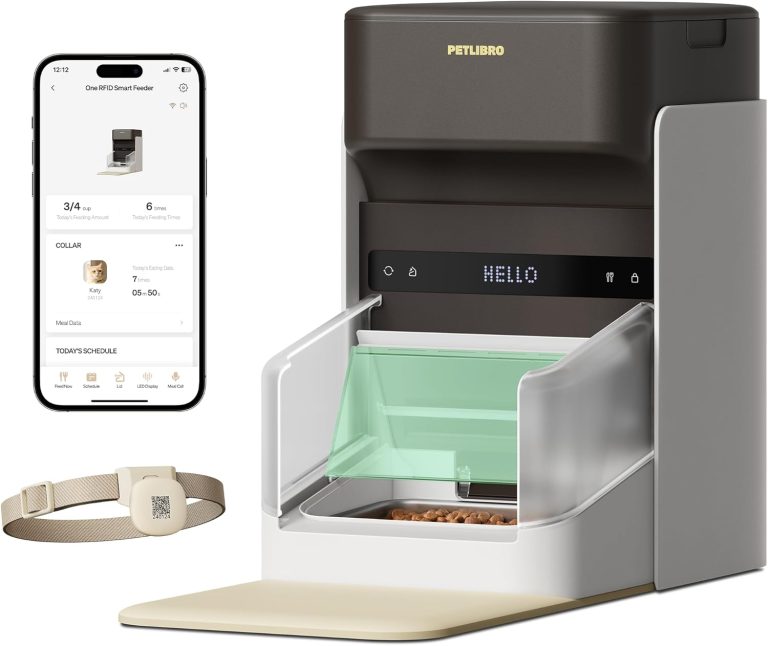
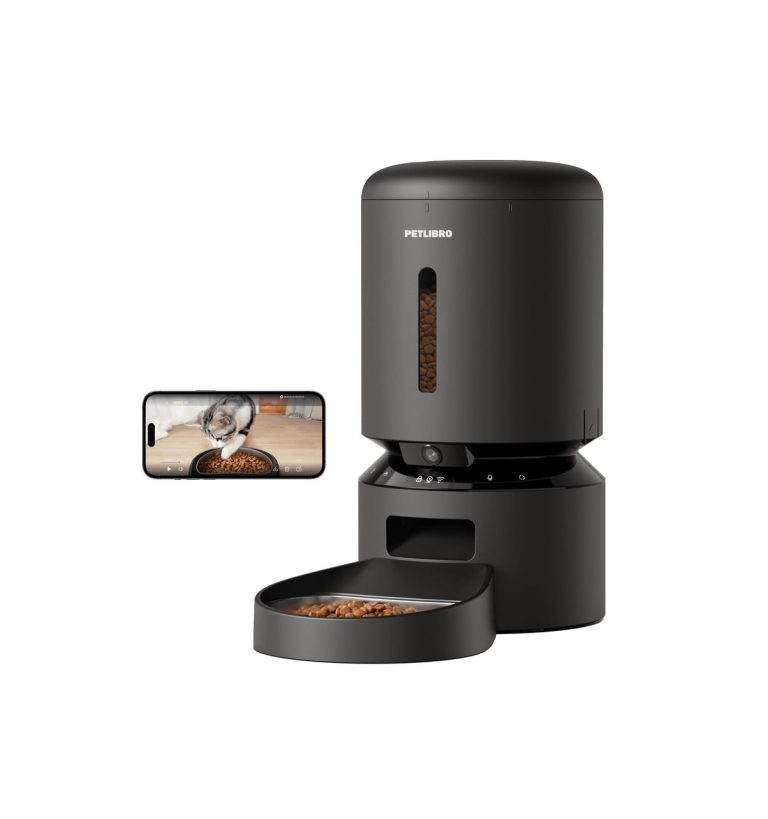
Smart feeders connect to your home WiFi and are controlled through a smartphone app. You can schedule meals, adjust portions, dispense manually, and receive notifications — all from anywhere. Higher-end models include cameras, two-way audio, and RFID tag readers for multi-cat households.
Best for: Tech-comfortable owners who want maximum flexibility and remote control. Multi-cat households (with RFID models). Owners who travel frequently.
Limitations: WiFi dependency. Higher cost. More components that can fail. App reliability varies significantly between brands.
Decision Criterion 1: Cost and Value
| Feeder Type | Initial Cost | Consumables | Long-Term Cost |
|---|---|---|---|
| Gravity | $15–$40 | None | Lowest |
| Timer | $30–$65 | Batteries ($5–10/year) | Low |
| Smart WiFi (basic) | $60–$100 | Batteries ($5–10/year) | Moderate |
| Smart WiFi (camera/RFID) | $100–$150 | Batteries, RFID tags | Higher |
Winner by cost: Gravity feeder. At $15–$40 with zero operating costs, it’s the cheapest option by far.
Best value: Timer feeder. For $30–$65, you get portion control and scheduling without ongoing costs beyond batteries.
Most expensive: Smart WiFi feeders, especially camera-equipped models. However, the additional features may justify the cost for frequent travelers or multi-cat households.
Decision Criterion 2: Portion Control
| Feeder Type | Portion Control | Accuracy | Best For |
|---|---|---|---|
| Gravity | None | N/A | Self-regulating cats |
| Timer (compartment) | Exact pre-loading | 100% | Strict diet plans |
| Timer (auger) | Programmed portions | ±10% | General portion control |
| Smart WiFi | Programmed portions | ±5–15% | Flexible portion adjustment |
Winner: Timer feeder (compartment type). Loading exact portions into each compartment gives you 100% control over how much food is dispensed. The Cat Mate C5000 is the gold standard here.
Decision Criterion 3: Schedule Flexibility
| Feeder Type | Meals Per Day | Schedule Changes | Remote Adjustment |
|---|---|---|---|
| Gravity | Unlimited (constant access) | N/A | N/A |
| Timer (mechanical) | Up to 5 | On-device only | ❌ |
| Timer (digital) | Up to 4 | On-device only | ❌ |
| Smart WiFi | 4–10+ | Anytime via app | ✅ |
Winner: Smart WiFi feeders. Up to 10 meals per day with the ability to change schedules instantly from your phone — even when you’re not home.
Decision Criterion 4: Vacation and Travel Suitability
| Feeder Type | Max Away Time | Wet Food | Backup Needed |
|---|---|---|---|
| Gravity | Until hopper empties (1–3 days) | No | None |
| Timer (compartment) | Up to 5 days | Yes (with ice packs) | Batteries |
| Timer (auger) | Up to 5 days | No | Batteries |
| Smart WiFi | 5–7+ days (large hopper) | Some models | Batteries + WiFi |
Winner: Smart WiFi feeder (large hopper models). With a 5–7 liter hopper and app control, you can monitor food levels and adjust portions remotely. The PETLIBRO Polar with the large hopper can last a full week on one fill.
However, for pure reliability without WiFi dependency, timer feeders with battery backup are a close second.
Decision Criterion 5: Multi-Cat Households
| Feeder Type | Multi-Cat Support | Food Stealing Prevention | Individual Portions |
|---|---|---|---|
| Gravity | ❌ (free access for all) | ❌ | ❌ |
| Timer | ⚠️ (separate feeders needed) | ❌ | ❌ |
| Smart WiFi (basic) | ⚠️ (separate feeders needed) | ❌ | ❌ |
| Smart WiFi (RFID) | ✅ (tag-recognized access) | ✅ | ✅ |
Winner: Smart WiFi with RFID (e.g., SureFeed Microchip, PETLIBRO Polar with RFID add-on). Only RFID/microchip feeders can distinguish between cats and prevent food stealing.
Decision Criterion 6: Wet Food Compatibility
| Feeder Type | Wet Food Support | Cooling | Best For |
|---|---|---|---|
| Gravity | ❌ | N/A | Dry food only |
| Timer (compartment) | ✅ (with ice packs) | Passive (ice pack) | Wet food up to 12 hours |
| Timer (auger) | ❌ | N/A | Dry food only |
| Smart WiFi (basic) | ❌ | N/A | Dry food only |
| Smart WiFi (cooling) | ✅ (Polar only) | Active (semiconductor) | Wet food up to 24 hours |
Winner: Smart WiFi with active cooling (PETLIBRO Polar). The only feeder that reliably keeps wet food fresh for 24 hours. The Cat Mate C5000 with ice packs is a close second for shorter periods.
Decision Criterion 7: Power Failure Handling
| Feeder Type | Power Required | Battery Backup | Duration |
|---|---|---|---|
| Gravity | None | N/A | Indefinite |
| Timer (mechanical) | Batteries only | Built-in (battery powered) | Months |
| Timer (digital) | AC or batteries | Yes (battery slot) | Weeks to months |
| Smart WiFi | AC | Yes (AA backup) | 2–7 days |
Winner: Timer feeder (mechanical). Battery-powered mechanical timers work for months on a single set of batteries. Gravity feeders need no power at all.
Smart feeders have the weakest power failure performance — backup batteries typically last only a few days without AC power.
Decision Criterion 8: Noise Level
| Feeder Type | Noise Level (dB) | Comparison |
|---|---|---|
| Gravity | 0 dB (silent) | No moving parts |
| Timer (mechanical rotation) | 25–30 dB | Gentle rotation |
| Timer (digital auger) | 35–45 dB | Moderate |
| Smart WiFi (auger) | 35–50 dB | Varies by brand |
Winner: Gravity feeder. Completely silent. For owners with noise-sensitive cats, gravity feeders are ideal.
Among scheduled feeders, the Cat Mate C5000’s mechanical rotation at ~30 dB is the quietest option.
Decision Criterion 9: Reliability and Longevity
| Feeder Type | Typical Lifespan | Common Failure Points | Repair Difficulty |
|---|---|---|---|
| Gravity | 5–10+ years | None (no moving parts) | N/A |
| Timer (mechanical) | 5–8 years | Timer mechanism, tray wear | Low |
| Timer (digital) | 3–5 years | Electronics, button failure | Moderate |
| Smart WiFi | 2–4 years | WiFi module, motor, app | High |
Winner: Gravity feeder. No moving parts means nothing to break. Timer feeders (mechanical) are a close second with proven 5+ year lifespans.
Smart WiFi feeders have the shortest lifespan due to electronic complexity and WiFi module vulnerability.
Decision Criterion 10: Ease of Cleaning
| Feeder Type | Bowl Material | Dishwasher Safe | Cleaning Frequency |
|---|---|---|---|
| Gravity | Varies (often plastic) | Usually hopper only | Weekly |
| Timer (compartment) | Plastic | Top rack (tray only) | Weekly |
| Timer (digital) | Plastic or stainless | Bowl only | Weekly |
| Smart WiFi | Plastic or stainless | Bowl only | Weekly |
Winner: Smart WiFi with stainless steel bowl. Stainless steel is the easiest to clean and most hygienic. The PETLIBRO Polar and PETKIT Fresh Element both have dishwasher-safe stainless steel bowls.
Scenario-Based Recommendations
Buy a Gravity Feeder if:
- Your cat self-regulates their eating
- You want the cheapest possible solution
- You value silence over features
- You need a feeder that works regardless of power or technology
- You feed only dry food
Buy a Timer Feeder if:
- Your cat needs portion control
- You want scheduled meals without WiFi
- You need wet food capability (Cat Mate C5000 with ice packs)
- You want proven reliability over 5+ years
- You prefer simple, mechanical design over smart features
Buy a Smart WiFi Feeder if:
- You want to control feeding from your phone
- You travel frequently and need remote monitoring
- You need 6–10 small meals per day (IBD, diabetic, or kitten schedules)
- Multi-cat RFID recognition is important to you
- You’re comfortable with app-based technology
Decision Matrix: Quick Pick by Scenario
| Your Situation | Best Feeder Type | Recommended Model |
|---|---|---|
| Single cat, self-regulates, tight budget | Gravity | PetSafe Healthy Pet Gravity |
| Portion control, no WiFi needed | Timer | Cat Mate C5000 |
| Wet food daily, app control | Smart WiFi | PETLIBRO Polar |
| Multi-cat, food stealing prevention | Smart WiFi (RFID) | SureFeed Microchip |
| Vacation coverage (5 days) | Timer | Cat Mate C5000 |
| Vacation coverage (7 days) | Smart WiFi | PETLIBRO Polar (large hopper) |
| Kitten or senior small meals | Smart WiFi | PETKIT Fresh Element |
| Minimalist, reliable, long-lasting | Timer | Cat Mate C5000 |
Final Verdict
There is no universal “best” feeder type — only the best type for your situation.
Gravity feeders remain the right choice for a specific niche: self-regulating cats on dry food only, where silence and simplicity matter most.
Timer feeders (especially the compartment-based Cat Mate C5000) are the most versatile and reliable option for most cat owners. They offer portion control, wet food capability, and multi-day scheduling without WiFi dependency.
Smart WiFi feeders are the future of cat feeding, but the technology is still maturing. They excel at flexibility and remote control but lag behind simpler feeders in long-term reliability.
If we had to recommend one feeder for the average first-time buyer, it would be the Cat Mate C5000 — it’s inexpensive, reliable, handles both wet and dry food, works for 5 days on batteries, and requires no app, no account, and no troubleshooting. It just works.
FAQ
Can a gravity feeder make my cat overweight?
Yes. Without portion control, cats that overeat can quickly become overweight with a gravity feeder. Monitor your cat’s weight closely if using one.
How long do timer feeder batteries last?
Mechanical timer batteries typically last 3–6 months. Digital timer batteries last 1–3 months. Always keep spares.
Can I use a smart feeder without WiFi?
Most smart feeders require WiFi for initial setup. After setup, many can operate on their programmed schedule without WiFi, but you lose remote control and notifications.
Which feeder type is best for kittens?
Smart WiFi feeders offer the meal frequency (4–6+ small meals per day) that kittens need. The PETKIT Fresh Element and PETLIBRO Polar both support frequent small meals.
Do I need a smart feeder if I work from home?
Not necessarily. If you’re home to supervise meals, a timer feeder with compartment-based dispensing is more reliable and less expensive than a smart feeder.
What’s the most reliable feeder type long-term?
Gravity feeders last the longest (no moving parts). Among scheduled feeders, mechanical timer feeders like the Cat Mate C5000 have proven 5–8 year lifespans.