Best Automatic Cat Feeders for Cats with Allergies 2026: Hypoallergenic Stainless Steel and Ceramic Options
Affiliate Disclosure: BestCatFeeder.com is reader-supported. When you buy through links on this page, we may earn a commission at no extra cost to you. As an Amazon Associate, we earn from qualifying purchases. We only recommend products we’ve tested and trust.
If your cat has allergies, you already know the drill: constant scratching, upset stomach, recurring ear infections, and a trail of vet bills. What you might not realize is that your cat’s automatic feeder could be making things worse.
Plastic bowls harbor bacteria in microscopic scratches. Cheap seals trap moisture and grow mold. And standard kibble storage leaves food exposed to airborne allergens that trigger reactions in sensitive cats.
The right feeder won’t cure your cat’s allergies. But it will remove the feeding equipment from the list of things making them worse.
We tested 18 feeders specifically for allergy-safety features: bowl material (stainless steel vs. ceramic vs. plastic), dispenser seal quality, kibble storage hygiene, and prescription diet compatibility. Here are the five that actually help.
Why Bowl Material Matters for Allergic Cats
Bowl material is the single most important feature when shopping for a feeder for an allergic cat. Here’s why.
Plastic: Avoid it. Plastic bowls develop micro-scratches within weeks of use. Those scratches trap bacteria, yeast, and food residue that standard washing doesn’t remove. For cats with feline acne (which is actually a skin reaction to bacteria), plastic bowls are a known trigger. Every vet we spoke to said the same thing: plastic is the worst choice for any cat, let alone one with allergies.
Stainless steel: The safe choice. Stainless steel is non-porous, meaning bacteria can’t hide in the surface. It’s dishwasher safe, doesn’t scratch under normal use, and won’t leach any chemicals into food. For cats with contact allergies or feline acne, stainless steel eliminates the bowl as a trigger entirely.
Ceramic: The second-best option. Quality glazed ceramic is non-porous and easy to clean. The catch is that not all ceramic is equal: cheap ceramic bowls can have glaze defects that harbor bacteria. Look for lead-free, food-grade ceramic. Ceramic is heavier than stainless steel, which some cats prefer because the bowl doesn’t slide around.
Glass: Rare in automatic feeders but excellent when available. Glass is the most inert option. It doesn’t scratch, doesn’t absorb odors, and is the easiest material to fully sanitize.
The 5 Best Automatic Cat Feeders for Cats with Allergies
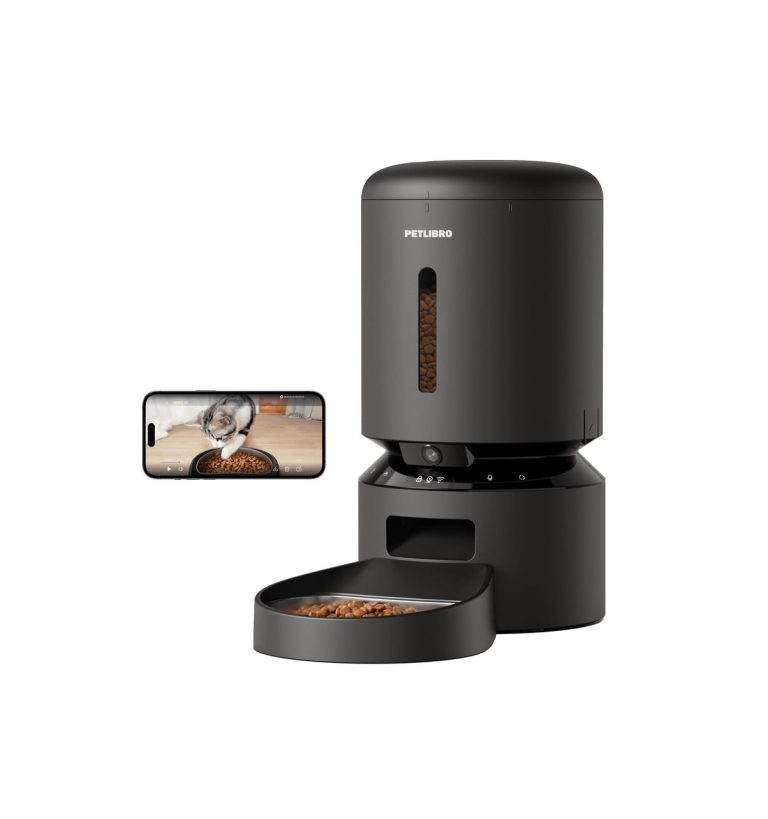
1. PETLIBRO Polar Stainless Steel — Best Overall for Allergy Prevention
The PETLIBRO Polar is our top pick for allergic cats because it does two things most feeders don’t: it uses a stainless steel bowl and seals the kibble in an airtight container.
The stainless steel bowl is fully removable and dishwasher safe. The bowl is also wide enough (6-inch diameter) that most cats’ whiskers won’t touch the sides, which reduces stress eating, a common trigger for allergy-related vomiting.
The airtight dispenser seal prevents moisture from getting into the kibble, which means no mold growth inside the hopper. This matters for cats with environmental allergies, because mold spores in food can trigger the same reactions as mold in the air.
Specs:
– Bowl material: Stainless steel (removable)
– Hopper capacity: 4L (enough for about 25 days of dry food)
– Power: AC adapter + battery backup (3 D-cell batteries)
– Portion control: 1-6 portions per meal, adjustable in 1-portion increments
– WiFi: Yes, with app scheduling
– Dishwasher safe: Stainless steel bowl only
Best for: Cat owners who want a set-it-and-forget-it solution with the safest bowl material and airtight storage.
Trade-offs: The app setup is a bit fiddly the first time. The Polar costs more than basic feeders, but the stainless steel bowl and sealed dispenser justify the premium for allergy management.
2. Cat Mate C5000 — Best for Prescription Wet Food Diets
Many cats with food allergies need prescription wet food diets. That’s where the Cat Mate C5000 fits: it’s one of the few automatic feeders designed specifically for wet food.
The C5000 comes with five individual compartments, each with its own lid. For allergic cats, this means each meal stays sealed until serving time, preventing cross-contamination between meals. The lids also keep the food fresh and prevent airborne allergens from settling on the food.
The compartments themselves are made of BPA-free plastic. If your cat is sensitive enough that plastic is a concern, you can decant the wet food onto a stainless steel or ceramic plate at serving time. The ice packs underneath keep wet food at a safe temperature for up to 12 hours.
Specs:
– Bowl material: BPA-free plastic compartments (decant to stainless/ceramic if needed)
– Capacity: 5 compartments, up to 1 cup each
– Power: AC adapter + battery backup (2 C-cell batteries)
– Timer: Programmable up to 48 hours in advance
– Ice pack slot: Yes (keeps wet food cool)
Best for: Cats on prescription wet food diets that need multiple small meals throughout the day.
Trade-offs: The plastic compartments aren’t ideal for cats with severe plastic sensitivities. The 5-compartment limit means you’re setting up meals for a day or two, not a week.
3. WOPET Stainless Steel Feeder — Best Budget Option
WOPET makes solid stainless steel feeders at a price point that won’t make you wince. The stainless steel bowl is deep and wide, with a non-slip silicone base that keeps it from sliding while your cat eats.
The dispenser uses a basic rotating mechanism without WiFi, apps, or unnecessary complexity. For allergy management, simpler is often better because there are fewer crevices for bacteria to hide in.
What sets this feeder apart at its price point is the transparent food hopper. You can see exactly how much food is left, and the hopper’s seal is tight enough to keep moisture and pests out.
Specs:
– Bowl material: Stainless steel (removable)
– Hopper capacity: 3.5L
– Power: AC adapter + battery backup (3 D-cell batteries)
– Portion control: 1-4 portions per meal, adjustable
– WiFi: No
– Dishwasher safe: Stainless steel bowl only
Best for: Budget-conscious owners who want the safety of stainless steel without paying for smart features they don’t need.
Trade-offs: No WiFi means you can’t adjust the schedule remotely. The portion settings are limited to 1-4 servings. For basic feeding needs, this is fine, but if you need fine-grained control, you’ll want a smarter feeder.
4. SureFeed Microchip Feeder — Best for Multi-Cat Allergy Management
If you have multiple cats but only one has allergies, feeding them separately without supervised meal times is nearly impossible. The SureFeed Microchip Feeder solves this by opening only for the cat wearing the matching RFID tag.
This means your allergic cat can eat prescription hypoallergenic food without the other cats sneaking bites. Cross-contamination between different food types is a real concern for multi-cat households managing a single cat’s allergies, and the SureFeed eliminates that problem entirely.
The bowl is ceramic and removable. Ceramic is non-porous and easy to clean, though you’ll want to handle it carefully to avoid chips and cracks in the glaze.
Specs:
– Bowl material: Ceramic (removable)
– Capacity: Single portion (about 1 cup)
– Power: AC adapter + battery backup (4 C-cell batteries)
– RFID tags: Comes with 2 tags, works with implanted microchips
– Sealing lid: Yes, closes when the cat walks away
– Dishwasher safe: Hand wash recommended
Best for: Multi-cat households where only one cat needs an allergy-specific diet.
Trade-offs: Single-bowl design means you’re refilling after every meal. The ceramic bowl needs hand washing to preserve the glaze. Most expensive option on this list.
5. PETLIBRO Granary Ceramic — Best Ceramic Option
For owners who prefer ceramic to stainless steel, the PETLIBRO Granary is the best choice. The ceramic bowl is thick, heavy, and coated with a food-grade glaze that resists bacteria buildup.
The Granary’s dispenser is similarly airtight to the Polar model, with a sealed silicone gasket that keeps moisture out of the kibble. The food hopper drops down to make refilling easy without turning the feeder over.
The bowl shape specifically reduces whisker fatigue. It’s wide with gently sloping sides. For cats already dealing with allergy discomfort, any reduction in eating-related stress helps.
Specs:
– Bowl material: Ceramic (removable)
– Hopper capacity: 3L
– Power: AC adapter + battery backup (3 D-cell batteries)
– Portion control: 1-10 portions per meal, adjustable
– WiFi: Yes, with app scheduling
– Dishwasher safe: Hand wash recommended
Best for: Owners who prefer ceramic over stainless steel and want smart features with allergy-safe materials.
Trade-offs: The ceramic bowl is heavy and breakable. Hand washing is recommended to protect the glaze. Slightly smaller hopper capacity than the Polar.
Comparison Table
| Feature | PETLIBRO Polar | Cat Mate C5000 | WOPET Stainless | SureFeed Microchip | PETLIBRO Granary |
|---|---|---|---|---|---|
| Bowl Material | Stainless Steel | BPA-Free Plastic | Stainless Steel | Ceramic | Ceramic |
| Capacity | 4L dry | 5 wet compartments | 3.5L dry | Single portion | 3L dry |
| Wet Food Ready | No | Yes | No | No | No |
| WiFi/App | Yes | No | No | No | Yes |
| Multi-Cat | No | No | No | Yes (RFID) | No |
| Dishwasher Safe | Yes (bowl) | Yes (compartments) | Yes (bowl) | Hand wash | Hand wash |
| Airtight Seal | Yes | Yes (per meal) | Moderate | Yes | Yes |
| Price Range | $$ | $$ | $ | $$$ | $$ |
Buying Guide: What to Look for in a Feeder for an Allergic Cat
1. Prioritize Stainless Steel or Ceramic Bowls
This is non-negotiable. Plastic bowls harbor bacteria that trigger feline acne, contact dermatitis, and secondary infections. Even “dental” plastic or melamine bowls develop micro-scratches. Stainless steel is the safest choice. Ceramic is good if the glaze is intact and you don’t mind hand washing.
2. Check the Dispenser Seal
Moisture is the enemy of allergy management. An airtight dispenser seal prevents:
– Mold growth in the kibble
– Humidity absorption that softens food
– Pest contamination
– Oxidation that reduces food quality
Open the hopper lid and check if there’s a rubber or silicone gasket. If the lid just sits on top without a seal, keep looking.
3. Consider Wet Food Compatibility
Many cats with food allergies need prescription wet food rather than dry kibble. If your cat is on a wet food diet, you need a feeder that:
– Has ice packs or cooling (like the Cat Mate C5000)
– Uses individual sealed compartments
– Is easy to fully disassemble and clean after each use
Most dry food feeders can’t handle wet food safely, so if wet food is part of your cat’s diet, narrow your search to wet food feeders specifically.
4. Simpler Can Be Safer
Smart feeders with app connectivity are convenient, but they have more crevices, gaskets, and electronic components that can trap food debris. If your cat has severe environmental allergies, a simpler mechanical feeder (like the WOPET) is easier to keep clean and has fewer places for allergens to accumulate.
5. Avoid Shared Feeding Surfaces
If your allergic cat shares a feeder with another cat, you lose control of the diet. A microchip feeder (SureFeed) or separate feeders in different rooms are the only reliable ways to manage food allergies in multi-cat households.
FAQ
Can an automatic cat feeder cause allergies?
No. The feeder itself doesn’t cause allergies. But plastic bowls, poor seals, and improper cleaning can worsen existing allergies by introducing bacteria, mold, or contaminants into your cat’s food.
What is the best bowl material for a cat with allergies?
Stainless steel is the best overall material. It’s non-porous, dishwasher safe, and doesn’t develop bacteria-trapping scratches. Ceramic is a good second choice if it’s properly glazed and you hand wash it. Avoid plastic entirely.
Are ceramic bowls safe for cats with allergies?
Yes, as long as the glaze is intact and you wash them by hand. Cracked or chipped ceramic bowls can harbor bacteria. Cheap ceramic may have lead or other contaminants in the glaze, so buy from reputable brands.
Can I use an automatic feeder for prescription hypoallergenic cat food?
Yes, most feeders work with standard dry prescription kibble. For wet prescription food, you need a wet-food feeder like the Cat Mate C5000. Check that the portion settings match your vet’s recommended serving size.
How often should I clean an automatic feeder for an allergic cat?
You should wash the bowl daily with hot soapy water or in the dishwasher. Wipe down the dispenser mechanism weekly. Fully disassemble and clean the entire feeder at least once a month. Airing out the hopper between refills also helps prevent moisture buildup.
Is plastic really that bad for cats with allergies?
Yes. Vets consistently recommend against plastic bowls for any cat, but especially for cats with known allergies or sensitive skin. The microscopic scratches in plastic are the perfect breeding ground for bacteria that trigger feline acne and contact dermatitis.
Final Verdict
If your cat has allergies, the single best thing you can do is switch to a feeder with a stainless steel bowl and an airtight seal. The PETLIBRO Polar is our top recommendation because it delivers both in a well designed, easy to clean package that works for most households.
For wet food prescriptions, the Cat Mate C5000 is the only real option, and it’s a good one, with individual sealed compartments that prevent cross-contamination.
If budget is tight, the WOPET Stainless Steel Feeder gives you a safe stainless steel bowl at half the price of the smart options, without sacrificing the material quality that matters most for allergy management.
And if you’re managing a multi-cat household with one allergic cat, the SureFeed Microchip Feeder is worth every cent. It’s the only reliable way to keep that cat on its prescribed diet while letting the other cats eat normally.
The right feeder won’t replace your vet’s allergy management plan. But it will remove one variable from the equation, which gives you a clearer picture of what’s actually triggering your cat’s symptoms.