Best Automatic Cat Feeders for Cats with Food Guarding Behavior: 2026 Guide
Best Automatic Cat Feeders for Cats with Food Guarding Behavior: 2026 Guide
Executive Summary
Food guarding — also called food aggression or resource guarding — is a stress-driven behavior where a cat becomes protective, anxious, or aggressive around food. While often associated with multi-cat households, it can also affect single cats with a history of resource scarcity, anxiety, or territorial instincts.
The right automatic feeder can help reduce food guarding by:
– Providing predictable, consistent meal timing (reducing scarcity anxiety)
– Using slow-feed mechanisms (extending eating time and reducing urgency)
– Operating quietly (minimizing stress triggers)
– Covering or concealing food (reducing visual guarding triggers)
– Portion control (eliminating overeating-driven anxiety)
This guide covers feeder features that address food guarding, specific product recommendations, and behavior modification strategies to pair with feeding automation.
Top Pick for Food Guarding: Cat Mate C5000 — covered compartments reduce visual food fixation
Best Slow-Feed Design: Catit Pixia with slow-feed insert — extends mealtime
Best Quiet Operation: PETLIBRO DockStream — near-silent dispensing mechanism
Best Portion Control for Guarding Reduction: WOPET Automatic Feeder with small, frequent meals
Understanding Food Guarding in Single Cats
Why Single Cats Guard Food
Food guarding in single-cat households is often misunderstood. Common triggers include:
| Trigger | Behavioral Expression | How a Feeder Helps |
|---|---|---|
| Past resource scarcity (rescue/shelter history) | Eats frantically, guards bowl after finishing | Predictable multiple meals reduce scarcity mindset |
| Anxiety (separation, environmental changes) | Guards food area, refuses to leave bowl | Quiet, predictable feeder reduces stress triggers |
| Boredom-based food fixation | Stares at food area, obsesses over next meal | Timed dispensing removes owner as food source |
| Medical issues (hyperthyroidism, diabetes) | Constant hunger drives guarding behavior | Consistent portion control + medical management |
| Learned behavior from past multi-cat competition | Guards even when alone | Slow-feed mechanism extends eating time |
The key distinction from multi-cat food aggression: the single-cat guarder is not defending against others — they are responding to an internal sense of food insecurity.
Feeder Features That Address Food Guarding
| Feature | How It Helps Food Guarding | What to Look For |
|---|---|---|
| Covered/sealed compartments | Reduces visual fixation on food | Opaque lids, slow-close covers |
| Quiet dispensing | Won’t startle an anxious cat | Sound level <40 dB, dampened mechanism |
| Slow-feed design | Extends eating time, reduces urgency | Puzzle inserts, maze bowls, portion restrictors |
| Multiple small meals | Reduces scarcity anxiety | 4–6 meal programming capability |
| Timer-only (no app) | Predictable routine without variable human behavior | Simple mechanical timer |
| Stainless steel bowl | Hygienic, doesn’t retain stress pheromones | Removable, dishwasher-safe |
Top Automatic Feeders for Food Guarding Cats
1. Cat Mate C5000 — Best Covered Compartment Design
Why it fits: The C5000’s enclosed compartment design means food is hidden until dispensing time. The cat can’t see remaining food through a clear hopper — a major trigger for food-fixated cats.
Anti-guarding features:
– Opaque compartments hide food until scheduled time
– Rotating drum mechanism is relatively quiet
– Portion control via compartment size (fixed portions)
– 5-meal scheduling for frequent small feedings
– Ice packs available for wet food
Setup for food guarding reduction:
1. Start with 5 small meals rather than 2 large ones
2. Program first meal after the cat’s typical morning guarding peak
3. Use gradually decreasing portion sizes in later compartments
4. Place feeder in a quiet corner away from windows
Considerations: Compartments are fixed size; rotating mechanism can be heard by sensitive cats. Lid is not completely cat-proof for determined guarders.
2. Catit Pixia with Slow-Feed Insert — Best for Extended Mealtime
Why it fits: The Catit Pixia’s modular design accepts slow-feed inserts that require the cat to work for food — extending eating time from 30 seconds to 3–5 minutes, which reduces the frantic “eat everything now” urgency.
Anti-guarding features:
– Slow-feed maze insert physically extends mealtime
– RFID tag option for single-cat access control
– Ramp design reduces neck strain during eating
– Modular bowl system — easy to add puzzle elements
– Quiet operation
Setup for food guarding reduction:
1. Install the slow-feed maze in the Pixia bowl
2. Use the lowest portion setting initially
3. Gradually increase portion size as eating pace slows
4. Pair with scheduled dispensing for automatic slow meals
Considerations: RFID functionality requires tag purchase. Slow-feed inserts may frustrate some cats — introduce gradually.
3. PETLIBRO DockStream — Quietest Operation for Anxious Cats
Why it fits: The DockStream’s dispensing mechanism operates at under 35 dB — barely audible from across the room. For cats that guard food due to anxiety, eliminating startling feeder noise reduces stress triggers.
Anti-guarding features:
– Near-silent dispensing mechanism
– WiFi scheduling removes owner from feeding equation
– Camera for remote stress-level monitoring
– Gradual food release (not a sudden kibble dump)
– Stainless steel bowl (no plastic smell)
Setup for food guarding reduction:
1. Set 4–6 small meals spaced 4–6 hours apart
2. Use the app’s “gentle dispensing” setting if available
3. Position camera to monitor guarding behavior
4. Gradually reduce owner presence during feeding times
5. Use consistent schedule timing (same times daily)
Considerations: Dry food only. Clear hopper may visually trigger some guarders — consider a hopper cover or positioning feeder to obscure view of remaining kibble.
4. WOPET Automatic Feeder — Best for Small, Frequent Meals
Why it fits: The WOPET’s simple 1–4 meal programming with small portion increments lets you create a “grazing-adjacent” schedule that mimics a plentiful food environment — directly countering the scarcity anxiety driving food guarding.
Anti-guarding features:
– Precise 1–4 portion control for small meals
– Voice recorder can play calming messages at feeding time
– Opaque hopper (standard on most models)
– Dual power for reliability
– Simple button operation — no app anxiety
Setup for food guarding reduction:
1. Program 4 small meals rather than 2 large ones
2. Record a calm, reassuring voice message
3. Use portion setting 1–2 for each meal initially
4. Maintain identical timing every day for 2 weeks
5. Once eating pace normalizes, gradually increase portions
Considerations: Basic timer only. Voice recording quality is limited. Some models have clear hopper windows — cover if visual trigger.
5. SureFeed Microchip Feeder — For Cats with Severe Guarding Around People
Why it fits: In rare cases, food guarding extends to aggression toward the owner during feeding time. The SureFeed dispenses food only when the cat approaches — no human interaction needed for the feeding event.
Anti-guarding features:
– Cat controls when food is accessed
– Sealed lid prevents visual food fixation
– No owner presence required for feeding
– Slow-close mechanism reduces urgency
– Portion tracking via app (Connect model)
Setup for food guarding reduction:
1. Place feeder in cat’s safe space
2. Load food before the guarding-prone time window
3. Let cat approach on its own schedule
4. Gradually decrease distance between feeder and owner presence
5. Use positive association treats near the feeder
Considerations: No built-in scheduling — this is access control only. One bowl limits meal quantity per loading.
Behavior Modification Protocol
Week 1–2: Setup and Predictability
- Choose feeder location in a quiet, low-traffic area
- Maintain exact same feeding schedule every day
- Let cat observe the feeder without eating for 2–3 days
- Start with feeder-powered mode (not batteries) for reliability
Week 3–4: Schedule Stabilization
- Increase feeding frequency to 4–5 small meals
- Remove any free-feed food sources
- Observe guarding behavior during dispensing — note triggers
- Use slow-feed or puzzle inserts if eating pace remains frantic
Week 5–8: Behavior Tracking and Adjustment
- Gradually increase portion sizes if eating pace stabilizes
- Introduce mild distractions during feeding (calming music, pheromone diffuser)
- Consider reducing feeding frequency to 3 meals if guarding subsides
- Track: time to approach feeder, eating duration, post-meal behavior
After 8 Weeks: Maintenance
- Maintain consistent schedule — this is the single most important factor
- Keep feeder as the sole food source
- Monitor for recurrence during stress periods (moves, visitors, schedule changes)
- Consider transitioning to gradual owner presence during feeding
What to Avoid
Feeder Features That May Worsen Food Guarding
| Feature | Why It Hurts | Alternative |
|---|---|---|
| Clear food hopper | Cat can see remaining food, fixates | Opaque hopper or covered feeder |
| Loud dispensing motor | Startles anxious cat during eating | Quiet mechanism (<40 dB) |
| Irregular schedule capability | Inconsistent feeding increases anxiety | Simple timer with fixed schedule |
| Treat dispenser feature | Overstimulates food drive | Avoid treat features during treatment |
| App-based variable scheduling | Introduces unpredictability | Set once, don’t adjust |
Comparison Table
| Feeder | Price | Quietness | Meals/Day | Slow-Feed | Wet Food | Cover Design | Best For |
|---|---|---|---|---|---|---|---|
| Cat Mate C5000 | $$ | Medium (rotating drum) | Up to 5 | No (fixed portion) | ✅ Yes | Opaque compartment | Visual food fixation |
| Catit Pixia | $$ | Quiet | Up to 10 | ✅ Add-on maze | ❌ No | Clear bowl (add cover) | Extended mealtime |
| PETLIBRO DockStream | $$$ | Very quiet (<35 dB) | Up to 6 | No | ❌ No | Clear hopper | Anxiety-sensitive cats |
| WOPET | $ | Moderate | Up to 4 | No | ❌ No | Opaque hopper | Small frequent meals |
| SureFeed Microchip | $$$ | Very quiet (lid only) | Manual loading | No | ✅ Yes | Sealed lid | Owner-aggression cases |
Breed-Specific Considerations
Cats with high prey drive or working-breed ancestry may be more prone to food guarding:
- Siamese/Oriental — Highly food-motivated; guarding often linked to boredom
- Bengal — High energy, food fixation; needs slow-feed and enrichment
- Maine Coon — Large size, can guard due to past competition history
- British Shorthair — Prone to obesity; guarding linked to food insecurity
- Rescue cats — Regardless of breed, past scarcity is a major guarding driver
FAQ
Q: Will an automatic feeder eliminate food guarding completely?
A: It is a powerful tool, but food guarding often has behavioral roots. An automatic feeder provides the consistent, predictable environment needed for behavior modification, but you may need to combine it with environmental enrichment, pheromone therapy, or veterinary behavior consultation.
Q: My cat only guards food when I’m home. Will an automatic feeder help?
A: Yes. The feeder removes you from the feeding event entirely. Your cat learns that food comes from the machine, not from you — reducing owner-directed guarding behavior.
Q: Should I choose a wet food or dry food feeder for a food-guarding cat?
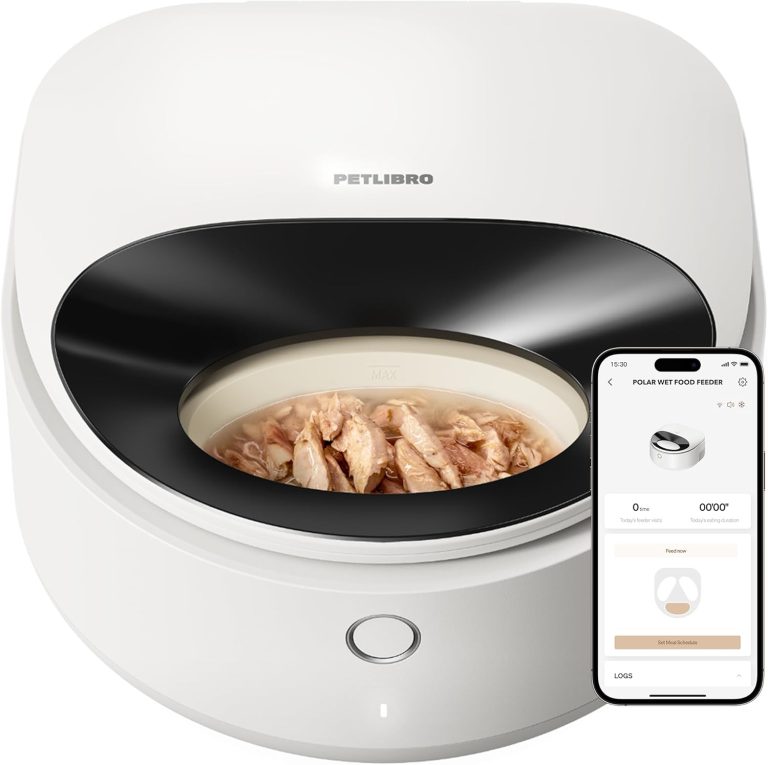
A: Wet food feeders (Cat Mate C5000, PETLIBRO Polar) offer covered compartments that reduce visual fixation. However, dry feeders with opaque hoppers can work equally well if the cat is not specifically triggered by dry food.
Q: How long does it take for food guarding to improve with an automatic feeder?
A: Most owners report noticeable improvement within 2–4 weeks of consistent feeder use. Severe guarding may require 8–12 weeks with additional behavior modification.
Q: Can I use an automatic feeder alongside food puzzles?
A: Absolutely. This is an excellent combination for food-guarding cats. Use the feeder for scheduled meals and food puzzles for between-meal enrichment.
Our Recommendation
For single-cat food guarding, start with the Cat Mate C5000. Its covered compartment design directly addresses visual food fixation — the most common guarding trigger — while providing the frequent small-meal schedule that reduces scarcity anxiety.
If your cat’s guarding is primarily anxiety-driven (rather than visual fixation), choose the PETLIBRO DockStream for its near-silent operation and consistent app-based scheduling.
Add a Catit Pixia slow-feed insert if your cat continues to eat too quickly after 4 weeks of feeder use.
Remember: a feeder is a tool, not a cure. Pair it with environmental enrichment, consistent routines, and — if guarding persists — a veterinary behaviorist consultation.
Last updated: July 2026. If food guarding is severe or accompanied by aggression toward humans, consult a veterinary behaviorist before introducing new feeding equipment.