Best Automatic Cat Feeders for Cats with Chronic Kidney Disease (CKD): 2026 Guide
Best Automatic Cat Feeders for Cats with Chronic Kidney Disease (CKD): 2026 Guide
Executive Summary
Chronic Kidney Disease (CKD) affects approximately 30% of senior cats over the age of 10, making it one of the most common health conditions in aging felines. Managing CKD requires strict attention to diet, hydration, medication timing, and feeding schedules — all areas where the right automatic feeder can make a meaningful difference.
This guide covers automatic feeders specifically suited for CKD management: portion-controlled dispensing for prescription renal diets, multi-meal programming for medication scheduling, hydration integration with water fountains, and features that support the unique needs of CKD cats.
Top Pick for CKD Management: PETLIBRO Polar Wet Food Feeder (cooled wet food for picky CKD eaters)
Best for Medication Scheduling: Cat Mate C5000 5-Meal Programmable Feeder
Best for Portion Control + Hydration: PETLIBRO DockStream with integrated water fountain pairing
Best on a Budget: WOPET Automatic Feeder with programmable portion sizes
Understanding CKD and Feeding Needs
Why Feeding Management Matters in CKD
Cats with CKD face several nutritional challenges that an automatic feeder can help address:
| CKD Challenge | Feeding Solution | Feeder Feature Required |
|---|---|---|
| Reduced appetite, frequent small meals | Multiple small meals throughout day | 4–6 meal programming, small portion sizes |
| Prescription renal diet requirements | Precise portion control | Programmable serving sizes (1/8 cup increments) |
| Medication timing (e.g., phosphorus binders, appetite stimulants) | Scheduled meals aligned with meds | 12-hour programming, multiple daily time slots |
| Increased hydration needs | Pairing with water fountain | Proximity to fountain, wet food option |
| Reduced thirst sensation | Wet food for moisture content | Insulated/wet food feeder with ice packs |
| Weight monitoring | Consistent daily portions | Logging or portion tracking |
Key CKD Dietary Requirements
- Low phosphorus — Prescription renal diets (Hill’s k/d, Royal Canin Renal, Purina NF) are formulated with restricted phosphorus
- High-quality protein — Limited but bioavailable protein sources to reduce kidney workload
- Omega-3 fatty acids — EPA/DHA to support kidney function
- B-complex vitamins — Water-soluble vitamins lost through increased urination
- Increased moisture — Wet food preferred; dry food may require additional water intake monitoring
Top Automatic Feeders for CKD Cats
1. PETLIBRO Polar Wet Food Feeder — Best for Moisture-Rich Meals
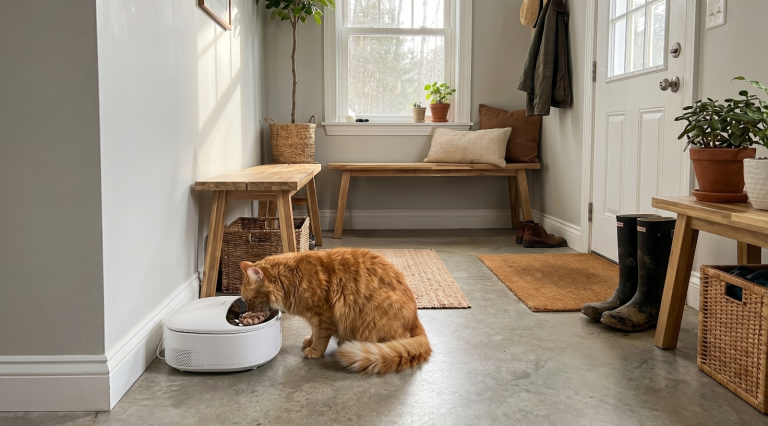
Why it fits CKD management: CKD cats benefit significantly from wet food due to its high moisture content. The PETLIBRO Polar is one of the few automatic feeders designed specifically for wet food, using dual ice packs to keep food fresh for up to 12 hours.
Key CKD-friendly features:
– Dual ice pack cooling system keeps wet renal diet fresh
– 4 meal compartments for small, frequent meals
– Removable stainless steel bowl (dishwasher safe, hygienic)
– Quiet operation (won’t startle a sick cat)
– Battery backup for power outages
Considerations: Max 4 meals per day; ice packs need daily rotation. Not suitable for multi-day meal prep.
2. Cat Mate C5000 — Best for Medication Scheduling
Why it fits CKD management: The C5000’s 5-compartment design lets you pre-load meals with medication mixed in (e.g., phosphorus binders, calcitriol, appetite stimulants). Each compartment opens at its programmed time.
Key CKD-friendly features:
– 5 individual meal compartments with timed release
– Integrated ice packs for wet food freshness
– Clear lid lets you verify medication mixing before dispensing
– Programmable up to 48 hours in advance
– Runs on AC adapter or batteries
Considerations: Manual programming per compartment; rotating drum design may not suit all wet food consistencies. Lid is not fully cat-proof.
3. PETLIBRO DockStream — Best Portion Control + Hydration Pairing
Why it fits CKD management: Portion accuracy is critical with expensive prescription renal diets. The DockStream’s precise 1–8 portion settings and optional water fountain pairing make it ideal for CKD cats needing both measured meals and hydration encouragement.
Key CKD-friendly features:
– 1–8 portion settings for granular portion control
– WiFi-connected scheduling via app for remote adjustment
– Optional DockStream water fountain pairs directly
– Stainless steel bowl for hygiene
– Camera and treat toss for remote monitoring and interaction
Considerations: Dry food only; wet food cannot be used. App-dependent for advanced features.
4. WOPET Automatic Feeder — Budget-Friendly Portion Control
Why it fits CKD management: For owners managing CKD on a budget, the WOPET offers reliable portion control without breaking the bank. Prescription renal diets are already expensive — the feeder shouldn’t add to the cost.
Key CKD-friendly features:
– Programmable 1–4 meals per day with precise portion control
– Voice recorder for feeding reminders (helps with medication timing)
– Dual power supply (AC + battery backup)
– Simple button interface — no app required
– Large capacity (7L) for fewer refills
Considerations: Dry food only; basic scheduling compared to smart feeders.
5. SureFeed Microchip Feeder — For Multi-Cat CKD Management
Why it fits CKD management: In multi-cat households where only one cat has CKD, the SureFeed ensures the CKD cat gets its prescription diet while other cats can’t steal the food.
Key CKD-friendly features:
– Microchip/RFID tag detection for individual access
– Slow-close lid prevents other cats from pushing in
– Sealed bowl keeps food fresh for wet prescription diets
– Portion tracking via companion app
– Battery-powered with low-battery indicator
Considerations: Single-bowl design (one cat per feeder); expensive for multiple-cat setups. Best used alongside a second feeder for non-CKD cats.
CKD-Specific Feeding Strategies
Scheduling Meals Around Medication
CKD medication timing is critical. Here’s a typical schedule:
| Medication | Timing | Feeding Strategy |
|---|---|---|
| Phosphorus binders | With each meal | Mix into food before loading feeder compartments |
| ACE inhibitors (e.g., benazepril) | Every 12–24 hours | Schedule meals 30 min after morning and evening doses |
| Appetite stimulants (e.g., mirtazapine) | Every 48–72 hours | Not tied to feeding — monitor appetite response |
| Subcutaneous fluids | As prescribed by vet | Separate from feeding schedule |
| Calcitriol | Every 24 hours at bedtime | Program a small late-night meal to accompany |
Wet Food vs Dry Food Considerations
Wet food advantages for CKD:
– Higher moisture content (78–82% vs 6–10% for dry)
– Lower phosphorus per calorie
– More palatable for cats with reduced appetite
– Better for medication mixing
Dry food considerations:
– More economical for prescription diets
– Longer shelf life in feeder hopper
– Easier for automatic dispensing mechanisms
– Must pair with water fountain for hydration
Recommendation: Use a wet food feeder (PETLIBRO Polar or Cat Mate C5000) for primary meals and a dry food feeder for supplementary overnight feeding.
Hydation Integration
CKD cats need constant access to fresh water. Pair your automatic feeder with:
– Circulating water fountain — Encourages drinking (PETLIBRO DockStream’s optional fountain, Catit Flower Fountain)
– Separate fountain placement — Position within 2–3 feet of feeder to create a feeding station
– Wet food supplementation — Each wet meal provides approximately 60-80% of a cat’s daily water needs
Comparison Table
| Feeder | Price Range | Meal Capacity | Wet Food | Portion Control | Smart Features | Best For |
|---|---|---|---|---|---|---|
| PETLIBRO Polar | $$$ | 4 compartments | ✅ Yes | Fixed portion | Timer only | Wet food CKD diets |
| Cat Mate C5000 | $$ | 5 compartments | ✅ Yes | Fixed compartment | Timer only | Medication scheduling |
| PETLIBRO DockStream | $$$ | Up to 6 meals | ❌ No | 1–8 settings | WiFi + App + Camera | Dry food + hydration |
| WOPET | $ | Up to 4 meals | ❌ No | 1–4 settings | Basic timer | Budget CKD management |
| SureFeed Microchip | $$$ | Single bowl | ✅ Yes | N/A (single portion) | App tracking | Multi-cat prescription diet |
Setting Up Your CKD Feeding Station
Step-by-Step Plan
- Consult your veterinarian — Confirm the recommended renal diet brand, daily caloric intake, and medication schedule
- Choose feeder placement — Quiet corner away from foot traffic, near a water source
- Program meal schedule — Program smaller, more frequent meals (4–6) rather than 2 large ones
- Pre-load medications — If using phosphorus binders or other meal-timed meds, mix into individual compartments
- Monitor intake — Track how much your cat actually eats during the transition period (3–5 days)
- Adjust portions — Use the feeders’ portion controls to fine-tune based on appetite and weight trends
- Pair with hydration — Position fountain nearby; monitor water intake with CKD-appropriate tracking
Common Mistakes to Avoid
- Switching to a new diet too quickly — Transition over 7–10 days
- Overfilling compartments — CKD cats may eat less than expected; start with small portions
- Ignoring wet food freshness — Don’t leave wet food out longer than 12 hours (8 hours in warm weather)
- Neglecting bowl hygiene — Wash stainless steel bowls daily; renal diet residue can harbor bacteria
- Setting unrealistic schedules — Some cats need free-choice dry food alongside scheduled wet meals
FAQ
Q: Can I use a regular automatic feeder for CKD prescription dry food?
A: Yes, most automatic feeders work with standard kibble-shaped prescription dry foods. Stick with feeders that have stainless steel bowls and programmable portion sizes.
Q: How do I give medication with an automatic feeder?
A: Use a compartment-style feeder (Cat Mate C5000 or PETLIBRO Polar) and mix medication directly into the wet food for each timed compartment. Always verify with your vet that the medication can be mixed with food.
Q: My CKD cat has lost interest in eating. Will an automatic feeder help?
A: Yes — the novelty of food appearing at scheduled times can stimulate appetite. Some owners report that the sound of the feeder dispensing triggers their cat to approach and eat.
Q: Should I get a wet food or dry food feeder for CKD?
A: A wet food feeder is ideal for moisture content and medication mixing. However, a combination approach (wet feeder for primary meals + dry feeder for overnight top-ups) works well for many owners.
Q: How often should I clean my CKD cat’s feeder?
A: Daily bowl washing with hot soapy water. Weekly deep clean of the hopper and dispensing mechanism. CKD cats are more susceptible to bacterial infections.
Our Recommendation
For most CKD cat owners, we recommend the PETLIBRO Polar Wet Food Feeder as the primary meal feeder paired with a WOPET Automatic Feeder for supplemental dry food. This combination covers:
- Wet food moisture for kidney health
- Medication mixing in wet compartments
- Precise portion control for expensive prescription diets
- Affordable dry backup for overnight/supplemental feeding
- Multiple small meals throughout the day
Always work with your veterinarian when making dietary changes for your CKD cat. An automatic feeder is a tool to support — not replace — veterinary guidance.
Last updated: July 2026. Prices and availability may vary. Always consult your veterinarian before making dietary changes for a cat with CKD.