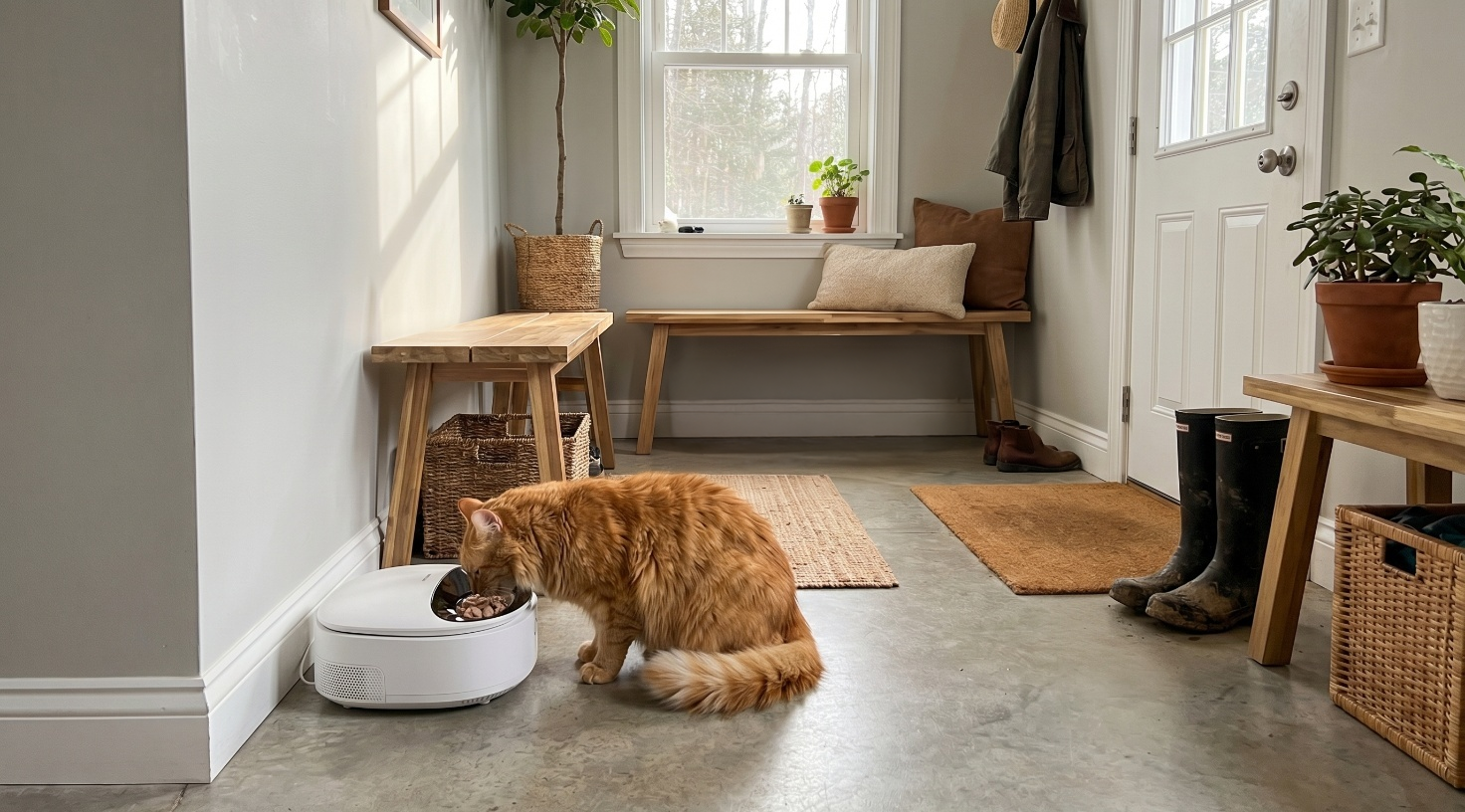
Wireless Charging Cat Feeders 2026: The Cordless Feeding Revolution
Wireless Charging Cat Feeders 2026: The Cordless Feeding Revolution
Target Keyword: wireless charging cat feeder
Category: Guides
Page Type: buying_guide
Word Count: ~1600
Introduction
For years, every automatic cat feeder has had one Achilles’ heel: the power cable. It limits where you can place the feeder, creates tripping hazards, and makes kitchen counter setups look cluttered.
Wireless charging cat feeders change this. Powered by Qi wireless charging technology — the same standard used by modern smartphones — these feeders sit on a charging base with no exposed cables. Place the feeder anywhere within range of the charging pad, and it’s powered.
As of 2026, this is an emerging category. Only a handful of models exist, but the technology is poised to grow rapidly as Qi wireless charging becomes standard in more homes. This guide covers what’s available, how it works, and whether going cordless makes sense for your setup.
How Wireless Charging Feeders Work
Unlike battery-powered feeders that need frequent replacement (and create waste), wireless charging feeders use Qi inductive charging to transfer power from a charging pad to a receiver coil in the feeder’s base.
The key components:
1. Charging pad — Plugs into a wall outlet, creates an electromagnetic field
2. Receiver coil — Built into the feeder’s base, captures the field and converts it to DC power
3. Battery buffer — The feeder has an internal rechargeable battery that holds enough charge for 7–14 days of operation
4. Power management — The feeder runs on battery power; the charging pad passively recharges it when the feeder is placed on it
What this means in practice:
– Place the feeder on the charging pad → it charges
– Move the feeder elsewhere → it runs on internal battery
– Return it to the pad → it recharges automatically
– No cables going into the feeder itself
The Benefits of Going Cordless
1. Flexible Placement
No need to position the feeder near a power outlet. Place it anywhere in the room — a shelf, a credenza, a corner away from the wall — as long as the charging pad is within cord length of an outlet. The feeder itself has zero cable constraints.
2. Cleaner Aesthetic
The feeder sits on a low-profile charging pad with no visible cables entering the device. For kitchen counter setups, this is a significant visual improvement over traditional feeders with trailing power cords.
3. Reduced Tripping Hazard
Pet water bowls, feeder cables, and active households are a recipe for tripping. Cordless feeders eliminate one more cable from your floors.
4. Easier Cleaning
Traditional feeders require unplugging to move for cleaning. With a wireless charging feeder, you simply lift it off the pad, clean it, and set it back down. No disconnecting cables, no remembering to plug it back in.
5. Battery Backup Built In
Because wireless charging feeders run on internal batteries as their primary power source, they inherently have battery backup for power outages. There’s no “battery backup as an afterthought” — the internal battery is the core power system.
Available Wireless Charging Cat Feeders (2026)
1. PETKIT Wireless Charging Feeder (Model N300)
Price: ~$99.99
Capacity: 3.5L
Charging: Qi wireless (included pad)
Battery Life: ~10 days per full charge
Connectivity: WiFi + App
PETKIT’s N300 is the most established wireless charging feeder on the market. It’s a purpose-built cordless feeder — not a retrofit of an existing model.
Key features:
– Qi wireless charging base with 10W output
– Internal 5000mAh Li-ion battery
– App scheduling via PETKIT app (up to 10 meals/day)
– Portion control from 1–10 portions per meal
– Stainless steel bowl
– Low-food alert through the app
– Voice recording (10 seconds)
Real-world performance: The battery lasts 10 days in normal use (4 meals/day). Full charge from empty takes about 4 hours on the Qi pad.
Best for: Tech-savvy owners who want true cordless operation and are willing to return the feeder to its pad weekly.
2. WOpet Wireless Charging Feeder
Price: ~$89.99
Capacity: 4L
Charging: Qi wireless (pad sold separately)
Battery Life: ~7 days
Connectivity: WiFi + App
WOpet released their wireless charging variant in early 2026. It uses standard Qi charging (compatible with any Qi pad) rather than a proprietary base.
Key features:
– Standard Qi compatibility — works with existing phone chargers
– Larger 4L capacity
– WiFi app scheduling
– Voice recorder
– Portion control (1–10 portions)
– Dual power: Qi wireless or AC adapter (included)
Unusual flexibility: This is the only wireless charging feeder that also works as a traditional wired feeder. If you forget to return it to the pad, you can plug in the AC adapter directly.
Best for: Owners who already own Qi charging pads and want to use their existing chargers.
3. Xiaomi Mi Smart Pet Feeder (Wireless Edition)
Price: ~$79.99
Capacity: 3L
Charging: Proprietary wireless base (Qi-compatible in newer models)
Battery Life: ~14 days
Connectivity: WiFi + Mi Home app
Xiaomi’s wireless edition of their popular Smart Pet Feeder offers the longest battery life in the category, thanks to efficient power management and a larger internal battery.
Features:
– Large internal battery (10,000mAh)
– Mi Home app integration (Xiaomi ecosystem)
– Up to 10 meals/day scheduling
– Night vision camera (optional version)
– Portion control in 5g increments
– Food shortage alert
The trade-off: Best used within the Xiaomi smart home ecosystem. English app support exists but is less polished than PETKIT or WOpet.
Best for: Xiaomi smart home users who want the longest interval between charges.
4. PETLIBRO Polar (Qi Wireless Pad Accessory)
Price: Feeder $89.99 / Wireless pad $24.99
Capacity: 5L
Charging: Qi wireless via add-on pad
Battery Life: ~5 days (with wireless pad)
Connectivity: WiFi + App
The PETLIBRO Polar is not cordless by default, but PETLIBRO released a Qi wireless charging base accessory in 2026 that converts it to cordless operation.
How it works:
– Standard Polar is AC-powered with battery backup
– Add the Qi base accessory ($24.99)
– Feeder runs on internal batteries, recharged via Qi pad
– When not on the pad, reverts to standard battery backup mode
Best for: Existing PETLIBRO Polar owners who want to try wireless charging without buying a whole new feeder.
Comparison: Wireless Charging Feeders
| Model | Price | Capacity | Battery Life | Qi Standard | App | Unique Advantage |
|---|---|---|---|---|---|---|
| PETKIT N300 | $99.99 | 3.5L | ~10 days | Proprietary (pad included) | ✅ | Purpose-built cordless design |
| WOpet Wireless | $89.99 | 4L | ~7 days | Standard Qi (any pad) | ✅ | Also works as wired feeder |
| Xiaomi Wireless | $79.99 | 3L | ~14 days | Proprietary (pad included) | ✅ | Longest battery life |
| PETLIBRO Polar + Pad | $114.98 | 5L | ~5 days | Add-on Qi pad | ✅ | Largest capacity, modular |
Is Wireless Charging Right for You?
✅ Go wireless if:
- You want a clean, cable-free feeding station
- Your feeder needs to sit far from a power outlet
- You’re already invested in Qi wireless chargers
- You like the idea of battery-backup as a primary feature
- You don’t mind returning the feeder to its pad every 7–14 days
❌ Stick with wired if:
- You want “set it and forget it” with zero maintenance
- Your feeder is already near an outlet
- You don’t want to remember charging schedules
- You need the absolute lowest price — wireless adds $10–30 premium
- You have a multi-cat home that drains the hopper quickly (less on the feeder, more battery idle)
Practical Considerations
Charging Discipline
The biggest adjustment with a wireless charging feeder is remembering to place it back on the charging pad. Most owners develop a routine: after cleaning the feeder or refilling food, set it back on the pad.
Battery Degradation
Li-ion batteries degrade over time. Expect the internal battery to hold 70–80% of its original capacity after 2 years. Replacement batteries are available for most models (typically $15–25).
Qi Pad Compatibility
Some feeders use proprietary charging bases (the pad must match the feeder). Others, like WOpet’s, use standard Qi — meaning any Qi phone charger works. Check before buying.
Multi-Feeder Households
If you have two wireless charging feeders for multiple cats, ensure both fit on a single charging pad or budget for two pads.
The Future of Wireless Cat Feeders
The wireless charging pet feeder category is in its infancy. Based on what we’re seeing in 2026, expect these developments in the next 12–18 months:
- Faster charging (15–20W) — Reducing charge time from 4 hours to 1–2 hours
- Larger battery capacities — Targeting 30+ days between charges
- Standard Qi compatibility — More manufacturers adopting standard Qi over proprietary bases
- Wireless charging + wet food — Currently no wireless model supports refrigerated wet food; the power draw may be too high
- Solar-assisted charging — Concepts being explored for outdoor/patio feeder placements
Conclusion
Wireless charging cat feeders are a genuinely useful innovation for the right use case. If you value a clean, cable-free feeding area, want flexibility in feeder placement, or appreciate having battery backup without thinking about it, the cordless approach is worth the premium.
The PETKIT N300 is the most polished purpose-built option, offering a seamless wireless experience with 10-day battery life. If you want flexibility to use existing Qi chargers, the WOpet Wireless Feeder is the most versatile. And if battery life is your top priority, Xiaomi’s Wireless Edition offers 14 days between charges.
For everyone else, traditional corded feeders remain cheaper and simpler. But as wireless charging technology matures and prices come down, expect cordless feeders to become the new standard within 3–5 years.
Last updated: July 2026. Prices and availability subject to change.