Best Automatic Cat Feeders for Cats with Constipation & Digestive Issues: 2026 Gentle Feeding Guide
Introduction
Chronic constipation affects roughly 10-15 percent of cats, with the numbers climbing in senior years. A cat with digestive motility issues needs steady hydration, frequent small meals, and consistent feeding timing. Miss a schedule or let the food bowl sit empty too long, and the digestive slowdown worsens.
An automatic feeder addresses the three root causes of constipation-related feeding failure: irregular meal timing that disrupts gut motility, dry food as the sole diet, and portion sizes too large for a sluggish digestive system to process. But the feeder itself matters. A feeder built for dry kibble only, one that cannot accommodate wet food, or one that traps bacteria in hard-to-clean crevices will not help a cat with chronic constipation.
The feeders below support digestive health feeding protocols: wet food compatibility for moisture intake, frequent small-meal programming, stainless steel bowls for hygiene, and consistent daily scheduling.
What to Look for in a Feeder for Cats with Constipation
Constipation management is about moisture and regularity.
1. Wet Food Compatibility
Veterinary guidelines for managing feline constipation emphasize moisture. Canned or pouched wet food contains 70-80 percent water versus 6-10 percent for dry kibble. Cats with constipation must stay hydrated, and wet food is the most reliable way to increase water intake. The feeder must handle wet food without jamming or bacterial buildup.
2. Frequent Small Meals (4-6 per Day)
A sluggish colon handles small volumes better than large ones. Four to six small meals spread across the day keep the digestive tract active without overwhelming it. Look for a feeder with at least 4 programmable meal slots, ideally more for flexibility.
3. Stainless Steel Bowls
Bacterial overgrowth can worsen digestive issues. Plastic bowls scratch and trap bacteria. Stainless steel is non-porous and dishwasher-safe, keeping each meal free from contamination.
4. Consistent Scheduling
Cats with constipation thrive on routine. Irregular feeding times disrupt peristalsis. A feeder with reliable daily scheduling, preferably battery-backed in case of power loss, eliminates meal-time variability.
5. Easy Disassembly for Daily Cleaning
Leftover food residue breeds bacteria and mold, which can trigger further digestive upset. Every part that touches food must come apart for cleaning. No hidden corners where food gets trapped.
6. Quiet Operation
Cats with chronic digestive issues are often seniors. A loud feeder can startle them and create negative associations with mealtime. Quiet mechanics reduce stress at feeding time.
Best Automatic Feeders for Cats with Constipation
1. Cat Mate C5000 – Best for Wet Food and Multiple Meals
Price: $75-$90
The Cat Mate C5000 handles wet food natively. Each of its two compartments holds a stainless steel bowl, and an ice pack underneath keeps wet food cold for up to 12 hours. The mechanical timer supports up to 5 meals per day, and the gravity-sealed lids operate silently.
Why it works for digestive health:
- Five meals per day. Supports the frequent feeding schedule that keeps the digestive tract active.
- Wet food ready. Handles pates, mousses, and stews without mechanical issues. No dry-food-only restriction.
- Stainless steel bowls. Removable and dishwasher-safe. No bacterial grooves.
- Silent operation. No motor. The only sound is the mechanical timer advancing.
- Battery backup. Runs on D-cell batteries independent of wall power.
- Ice pack cooling. Keeps wet food at safe temperatures for 10-12 hours, preventing spoilage in warm environments.
Limitations:
– No app or notifications. You set it and check it manually.
– Each compartment dispenses the full bowl at once. Portion control is by bowl size, not gram-precision.
2. PETLIBRO Polar – Best for Wet Food Cooling and Remote Adjustments
Price: $90-$120
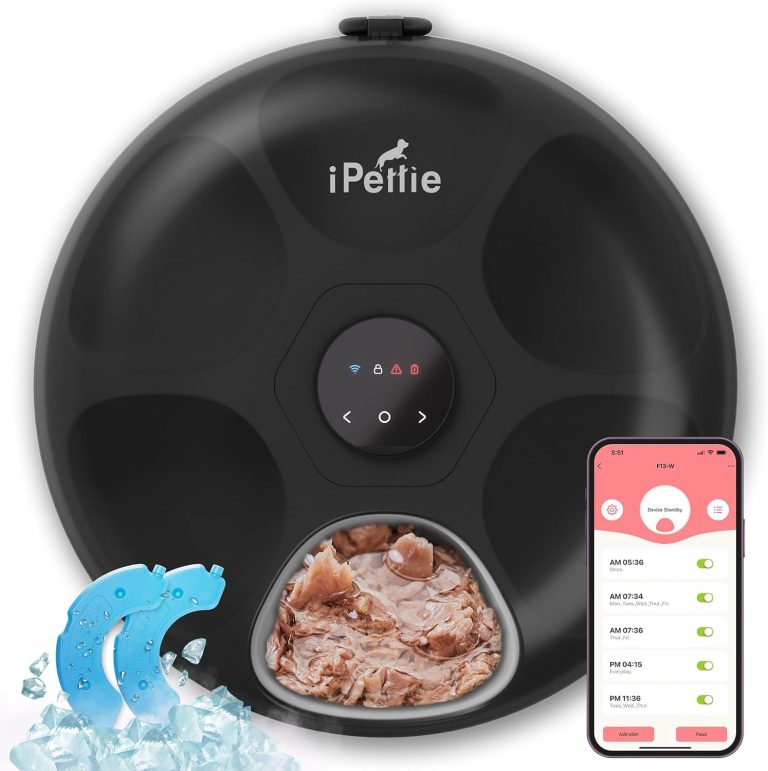
The PETLIBRO Polar is a wet-food-specific feeder with a built-in ice pack compartment, dual stainless steel bowls, and app-controlled scheduling. It supports up to 10 meals per day via the PETLIBRO app, enough to manage a full digestive health feeding protocol.
Why it works for digestive health:
- Up to 10 meals per day. More meal slots than any other wet food feeder. You can divide the daily intake into very small, frequent portions.
- App scheduling. Adjust meal times remotely. If your cat’s digestion needs change, you can tweak the schedule from your phone.
- Dual stainless steel bowls. Rotating design serves one bowl while the other stays covered and cool.
- Ice pack cooling. Keeps each portion cold until serving time.
- Quiet operation. The rotation mechanism runs briefly and at low volume.
- Battery backup. Dual power: USB-C and battery fallback.
Limitations:
– Requires the PETLIBRO app for full scheduling (WiFi setup needed).
– The ice packs need pre-freezing. If you forget, the cooling window is lost.
– Cleaning requires disassembling the rotating drum, which takes a few extra minutes compared to the Cat Mate.
3. PETKIT Fresh Element Solo – Best for Portion Precision and Prescription Diets
Price: $100-$130
The PETKIT Fresh Element Solo is a dry food feeder with precision portion control, a desiccant drying box to keep kibble fresh, and app-based scheduling. While it is dry-food-only, its portion accuracy and freshness features make it a strong choice for cats whose digestive issues are managed with a high-moisture dry prescription diet or a mixed wet-and-dry protocol.
Why it works for digestive health:
- Desiccant drying box. Keeps kibble fresh and free from moisture that can promote bacterial growth. Important for sensitive digestive systems.
- Precision portion control. Set exact gram portions per meal rather than volume-based dispensing. Useful for managing prescription diet quantities.
- 1-6 meals per day. Covers the minimum feeding frequency needed.
- App scheduling and notifications. Know when your cat has eaten. Get alerts if a meal was missed.
- Stainless steel bowl. Removable and dishwasher-safe.
- Battery backup. Runs on AA batteries in case of power loss.
- Quiet dispensing. The auger mechanism is quieter than most competitor dry feeders.
Limitations:
– Dry food only. Not compatible with wet food. If your cat’s constipation protocol relies on wet food, this feeder will not work as a primary option.
– Smaller bowl capacity. May need refilling every 1-2 days for multi-meal schedules.
– App dependency. Full functionality requires the PETKIT app and WiFi setup.
When to buy it anyway: If your veterinarian has prescribed a high-fiber dry diet for constipation management, or if you are combining wet meals from a separate feeder with dry portions from the Fresh Element Solo. The desiccant system keeps the dry kibble crisp and free from humidity.
Comparison Table
| Feature | Cat Mate C5000 | PETLIBRO Polar | PETKIT Fresh Element Solo |
|---|---|---|---|
| Price | $75-$90 | $90-$120 | $100-$130 |
| Max daily meals | 5 | 10 | 6 |
| Wet food | Yes | Yes | No |
| Stainless steel bowls | Yes | Yes | Yes |
| Cooling/Ice packs | Yes (12h) | Yes (built-in) | No (desiccant drying) |
| App control | No | Yes (WiFi) | Yes (WiFi) |
| Battery backup | Yes (D-cells) | Yes (USB-C/battery) | Yes (AA) |
| Portion precision | Bowl-size | Bowl-size | Gram-exact |
| Quiet operation | Very quiet | Quiet | Quiet |
| Cleaning difficulty | Easy | Moderate | Moderate |
Feeding Protocol for Constipation Management
Sample 5-Meal Schedule with Cat Mate C5000
| Meal | Time | Type | Portion |
|---|---|---|---|
| Breakfast | 7:00 AM | Wet food (high moisture) | 1 compartment (bowl A) |
| Mid-morning | 10:00 AM | Wet food with fiber supplement | 1 compartment (bowl B) |
| Lunch | 1:00 PM | Wet food (high moisture) | Refill bowl A |
| Afternoon | 4:00 PM | Wet food with pumpkin puree | Refill bowl B |
| Dinner | 7:00 PM | Wet food (high moisture) | 1 compartment (bowl A) |
The Cat Mate C5000 can manage this schedule with one mid-day reload of the two bowls.
Sample 10-Meal Schedule with PETLIBRO Polar
| Meal | Time | Type | Portion |
|---|---|---|---|
| Early breakfast | 6:00 AM | Wet food | Small portion |
| Breakfast | 8:00 AM | Wet food with supplement | Small portion |
| Mid-morning | 10:00 AM | Wet food | Small portion |
| Late morning | 11:30 AM | Wet food with psyllium | Small portion |
| Lunch | 1:00 PM | Wet food | Small portion |
| Afternoon | 3:00 PM | Wet food | Small portion |
| Late afternoon | 5:00 PM | Wet food with supplement | Small portion |
| Dinner | 7:00 PM | Wet food | Medium portion |
| Evening | 9:00 PM | Wet food | Small portion |
| Late night | 11:00 PM | Wet food | Small portion |
The PETLIBRO Polar supports the entire day without reloading.
Sample Mixed Protocol (Wet + Dry) with Cat Mate C5000 + PETKIT Fresh Element Solo
| Meal | Time | Type | Source |
|---|---|---|---|
| Breakfast | 7:00 AM | Wet food (high moisture) | Cat Mate C5000 |
| Mid-morning | 10:00 AM | Dry prescription fiber kibble | PETKIT Fresh Element Solo |
| Lunch | 1:00 PM | Wet food | Cat Mate C5000 |
| Afternoon | 4:00 PM | Dry prescription fiber kibble | PETKIT Fresh Element Solo |
| Dinner | 7:00 PM | Wet food | Cat Mate C5000 |
The combined approach gives your cat the moisture from wet meals plus the fiber content from prescription dry kibble.
Buying Guide: How to Choose
If Your Cat Eats Wet Food (Most Cats with Constipation)
Buy the Cat Mate C5000. It handles wet food, delivers 5 meals daily, costs under $100, and requires no app or WiFi. For cats that need wet food to stay hydrated, this is the most practical starting point.
If Your Cat Needs More Than 5 Meals or Remote Schedule Control
Buy the PETLIBRO Polar. The 10-meal capacity and app-based scheduling let you fine-tune the feeding routine without being home. Especially useful if your cat’s digestive needs change during flare-ups.
If Your Cat Is on a Prescription Dry Fiber Diet
Buy the PETKIT Fresh Element Solo. The desiccant drying system keeps high-fiber prescription kibble fresh, and the gram-exact portion control helps you follow the veterinarian’s feeding guidelines precisely.
If You Want Both Wet and Dry
Buy a Cat Mate C5000 for wet meals and a PETKIT Fresh Element Solo for dry prescription portions. This is the most complete setup: hydration from wet food, fiber from dry prescription diets, and full schedule coverage across the day.
Cleaning and Maintenance
Cats with digestive issues are more vulnerable to bacterial contamination. Cleaning protocol:
- Disassemble after each meal cycle. Remove bowls, compartments, and trays immediately.
- Wash with hot water and mild soap. No harsh chemicals that leave residue.
- Sanitize weekly. Run stainless steel parts through the dishwasher or use a diluted vinegar solution (1:4).
- Replace ice packs every 3 months if using a cooling feeder. Deteriorating ice packs can leak and contaminate food.
- Inspect bowls daily. Any scratches, cracks, or clouding means replacement. Damaged surfaces trap bacteria.
- For the PETKIT Fresh Element Solo, replace the desiccant pack every 2-3 months as recommended.
FAQ
Q: Can an automatic feeder help with my cat’s chronic constipation?
A: Yes, if used correctly. Consistent meal timing supports regular peristalsis. Wet food in the feeder increases moisture intake. The feeder supports the feeding plan but does not replace veterinary treatment. Consult your veterinarian for a full digestive health plan.
Q: Can I mix laxatives or fiber supplements into the feeder food?
A: Yes. The Cat Mate C5000 and PETLIBRO Polar both handle food with supplements mixed in. Add pumpkin puree, psyllium husk, or veterinary laxatives to the wet food before loading. Avoid adding them to the PETKIT Fresh Element Solo as the dry kibble auger can be affected by sticky additives.
Q: Should I use wet food or dry food for constipation?
A: Wet food is strongly preferred. The moisture content (70-80 percent) helps soften stool and keeps the colon hydrated. Dry food alone can worsen constipation. If you must use dry food, look for a high-fiber prescription formula and pair it with wet meals.
Q: Will the ice packs keep wet food safe all day?
A: The Cat Mate C5000 maintains below 40 degrees F for 10-12 hours. The PETLIBRO Polar’s built-in cooling works similarly. In warm climates (above 85 degrees F), check food temperature at the 8-hour mark.
Q: My senior cat has constipation and is hesitant about new things. How do I introduce the feeder?
A: Place the feeder near the current feeding area for 2-3 days with lids open. Let the cat investigate. Then load one meal into the feeder and trigger it while the cat watches. Gradually increase feeder-led meals over 5-7 days.
Q: What is the best feeding schedule for a cat with constipation?
A: Four to six small meals spread evenly across waking hours. Avoid going longer than 8 hours without food. Consistency matters more than the exact times. Pick a schedule and stick to it daily.
Final Verdict
| Scenario | Recommended Feeder | Why |
|---|---|---|
| Wet food diet, 5 meals daily | Cat Mate C5000 | Best value, wet food capable, silent, battery backup |
| 10+ small meals or remote control | PETLIBRO Polar | App control, 10-meal capacity, cooling built-in |
| Prescription dry fiber diet only | PETKIT Fresh Element Solo | Desiccant drying, gram-exact portions, app monitoring |
| Mixed wet and dry protocol | Cat Mate C5000 + PETKIT Fresh Element Solo | Full coverage: hydration + fiber + precision |
The Cat Mate C5000 is the practical starting point for most cats with constipation. It handles the wet food that provides the moisture these cats need, delivers 5 daily meals, costs under $100, and works entirely on a mechanical timer with battery backup. If your veterinarian prescribes a dry high-fiber diet alongside wet meals, add a PETKIT Fresh Element Solo for the dry portions.
Affiliate Disclosure: BestCatFeeder.com is reader-supported. When you buy through links on our site, we may earn an affiliate commission at no additional cost to you.