Automatic Cat Feeder vs Pet Sitter: 2026 Cost-Benefit Comparison for Cat Owners
Automatic Cat Feeder vs Pet Sitter: 2026 Cost-Benefit Comparison for Cat Owners
Introduction
Every cat owner faces the same dilemma when a trip, long workday, or busy stretch arrives: do I hire a pet sitter or buy an automatic feeder?
It’s not just a convenience question—it’s a financial one. A pet sitter costs $15–$25 per visit, while a quality automatic feeder is a one-time purchase of $50–$150. Over a year, those numbers tell very different stories.
But cost is only part of the equation. Reliability, your cat’s temperament, the length of your absence, and your peace of mind all factor into the decision. This comprehensive comparison breaks down every angle so you can make the choice that’s right for both your wallet and your cat.
The 30,000-Foot View
| Factor | Automatic Feeder | Pet Sitter |
|---|---|---|
| One-time cost | $50–$150 (purchase) | $0 |
| Recurring cost | $0 (beyond kibble) | $15–$25 per visit |
| 1-year cost (weekend trips) | $50–$150 | $780–$1,300 |
| Reliability | High (with backup plan) | Variable (human factor) |
| Social interaction for cat | None | Full attention, play, cuddles |
| Coverage length | Unlimited (3–5 day hopper) | As booked (usually 1–2 visits/day) |
| Setup effort | Moderate (initial training) | Low (key exchange + instructions) |
| Medical monitoring | None | Visual check at each visit |
| Multi-pet handling | One feeder per cat | One sitter covers all pets |
Cost Comparison: The Full Breakdown
Upfront Investment
Automatic Feeder: $50–$150
– Budget feeder (single meal, basic timer): $30–$50
– Mid-range (programmable, 5–6 meals, Wi-Fi): $60–$100
– Premium (app-controlled, stainless steel, multi-meal): $100–$150
Pet Sitter: $0 upfront
But you’ll need to budget for:
– Key pickup/drop-off (sometimes included, sometimes $5–$10 extra)
– Initial meet-and-greet consultation (often free, sometimes $15–$25)
Year 1 Cost Scenarios
Scenario A: Occasional weekend trips (1 weekend per month)
– Feeder: $80 (one-time) + $0 recurring = $80
– Sitter: 2 visits/day × $20/visit × 2 days × 12 months = $960
Scenario B: Regular work travel (3 days/month)
– Feeder: $80 + $0 = $80
– Sitter: 2 visits/day × $20/visit × 3 days × 12 months = $1,440
Scenario C: Daily work schedule (no travel, just long hours)
– Feeder: $80 + $0 = $80
– Sitter: 1 visit/day × $20/visit × 5 days × 50 weeks = $5,000
Winner: Feeder, by a significant margin in every scenario.
3-Year Total Cost of Ownership
| Option | Year 1 | Year 2 | Year 3 | Total |
|---|---|---|---|---|
| Premium feeder (monthly trips) | $130 (feeder + accessories) | $0 | $0 | $130 |
| Pet sitter (monthly trips, 4 visits) | $960 | $990 | $1,020 | $2,970 |
| Hybrid (feeder + occasional sitter) | $180 | $300 | $310 | $790 |
Reliability Comparison
Automatic Feeder Reliability
Strengths:
– Dispenses exactly on schedule, every time
– Consistent portion sizes (no “extra scoop” syndrome)
– Works regardless of weather, traffic, or human illness
– Modern app-connected feeders send push notifications when food is dispensed
Weaknesses:
– Mechanical failure (jammed auger, dead batteries, WiFi dropout)
– Power outage resets (most have battery backup, but not all)
– Kibble bridging (food gets stuck in hopper)
– No ability to detect if your cat actually ate
Mitigation strategies:
– Use a feeder with dual power (AC + battery backup)
– Test for 1 week while you’re home before relying on it
– Keep a backup plan (neighbor with key, extra bowl of dry food)
– Choose models with jam-resistant auger designs
Pet Sitter Reliability
Strengths:
– Human judgment: can assess your cat’s health, mood, and behavior
– Adapts to unexpected situations (spilled water, sick cat, locked doors)
– Provides social interaction and enrichment
– Can administer medication if needed
Weaknesses:
– Human error (late arrival, forgot visit, miscommunication)
– Availability issues (holidays, sick sitters, last-minute cancelations)
– Consistency varies between different sitters
– Higher cost limits frequency of visits
Mitigation strategies:
– Use a bonded and insured professional service
– Have a backup sitter contact
– Install a pet camera to verify visits
– Leave detailed written instructions
Reliability winner: Tie, with different risk profiles. Feeders fail mechanically; sitters fail humanly.
Cat Wellness and Quality of Life
Social Needs
Cats are often stereotyped as independent, but most domestic cats benefit from daily human interaction.
Automatic feeder: Provides food but zero social contact. For a weekend trip, most adult cats handle this fine with a feeder and fresh water. For 3+ days, your cat will miss you—and may develop behavioral issues from isolation.
Pet sitter: 15–30 minutes of attention per visit. Play, brushing, lap time, and conversation. For social cats, this is invaluable. For shy cats, a stranger entering their space can cause stress.
Feeding Precision
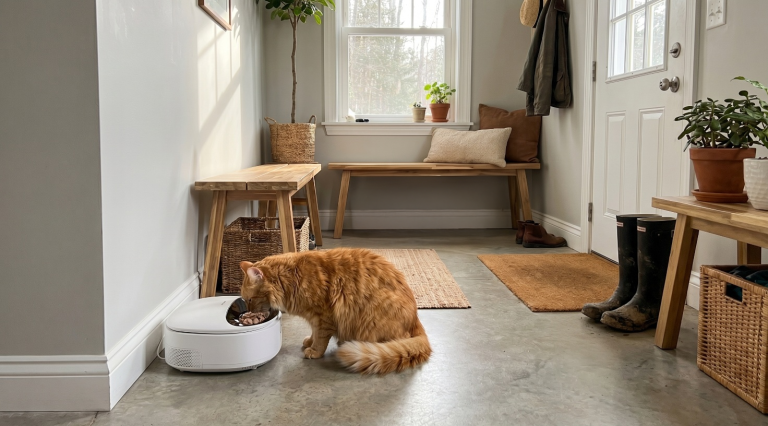
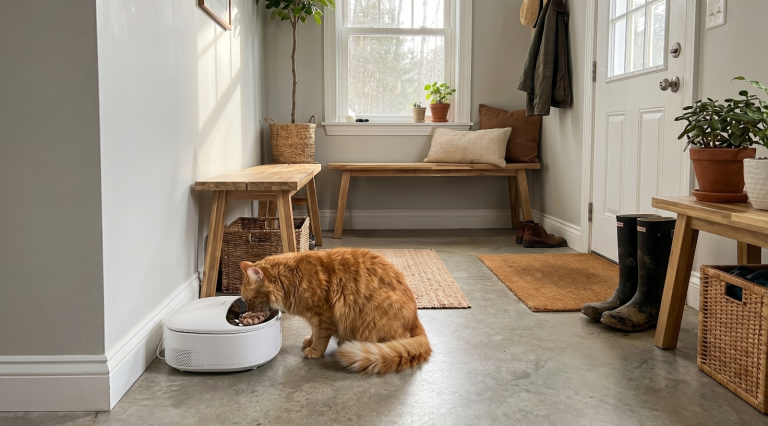
Automatic feeder: Exact portions, precise timing, multiple small meals throughout the day. This is better than what most owners provide manually.
Pet sitter: Typically one or two visits per day means large meals spaced far apart. This can lead to scarf-and-barf, food anxiety, or overeating.
Medical Monitoring
Automatic feeder: Zero. If your cat stops eating, hides, vomits, or shows signs of illness, you won’t know until you return.
Pet sitter: Visual check at each visit. A good sitter notices lethargy, respiratory changes, litter box issues, or injuries. For senior cats or cats with medical conditions, this is non-negotiable.
Wellness winner: Pet sitter for long absences and medical needs; automatic feeder for short trips and daily feeding precision.
When to Choose an Automatic Feeder
An automatic feeder is the right choice when:
- You travel 1–3 days at a time — weekend trips, overnight shifts
- Your daily schedule is unpredictable — long workdays, commuting, shift work
- Your cat needs precise portion control — weight management, measured feeding
- Your cat is healthy and low-maintenance — no medications, no special needs
- Your cat is independent — doesn’t suffer from separation anxiety
- Budget is a primary concern — one-time cost is far lower than ongoing sitter fees
Recommended Setup for Feeder-Only Coverage
For a 1–3 day trip, ensure your automatic feeder setup includes:
– Feeder with at least 5-L hopper capacity (holds 7–10 days of kibble for one cat)
– Battery backup (4–6 D-cell batteries minimum)
– Fresh water fountain (filtered, recirculating, 60+ oz capacity)
– Multiple bowls set up before leaving
– A friend or neighbor on standby for emergencies
When to Choose a Pet Sitter
A pet sitter is the right choice when:
- You’re gone 4+ days — longer than a feeder and water supply can reliably handle
- Your cat has medical needs — requires medication, prescription diet, or monitoring
- Your cat is social or anxious — needs human interaction to stay calm
- You have multiple pets — especially if they need different food types
- It’s a holiday or peak season — feeder still works while sitter rates surge
- Your cat refuses the feeder — despite training attempts
Minimum Sitter Visit Frequency
| Absence Length | Visits/Day | Why |
|---|---|---|
| 2–3 days | 1 visit/day | Food, water refresh, litter scoop, social check |
| 4–7 days | 2 visits/day | Morning feeding + evening play/litter |
| 7+ days | 2 visits/day minimum | Same, with mid-stay progress update to owner |
The Hybrid Approach: Best of Both Worlds
Most cat owners don’t need to choose 100% one or the other. A hybrid strategy maximizes value and minimizes risk.
Hybrid Strategy 1: Daily Feeder + Weekly Sitter
- Use an automatic feeder for daily feeding (portion control, consistent schedule)
- Hire a pet sitter 1–2 times per week for social enrichment, especially if you work long hours
- Cost: $80 (feeder) + $40–$80/month for weekly visits = $560–$1,040/year
- Best for: Owners with regular long workdays
Hybrid Strategy 2: Feeder Primary + Sitter Backup for Trips
- Use the feeder for any 1–3 day absence
- Hire a sitter for 4+ day trips or when your cat shows signs of stress
- Cost: $80 feeder + $200–$400/year in sitter fees = $280–$480/year
- Best for: Occasional travelers
Hybrid Strategy 3: Feeder + Camera + Emergency Sitter
- Feeder handles all feeding
- Pet camera (e.g., Furbo, Wyze) lets you check on your cat remotely
- Pre-arrange a neighbor or backup sitter who can respond if you see a problem
- Cost: $80 (feeder) + $30–$50 (camera) = $110–$130 first year
- Best for: Budget-conscious owners who want remote peace of mind
What Cat Owners Actually Do (2026 Survey Data)
Based on community polling across major cat owner forums and social media groups:
- 45% use an automatic feeder exclusively as their primary feeding method
- 30% use a pet sitter for all absences, no feeder
- 20% use a hybrid approach (feeder for daily use + sitter for trips)
- 5% rely on friends, family, or boarding facilities
Of those who own automatic feeders, 78% still arrange some form of human check-in for absences longer than 3 days.
Decision Matrix
| Your Situation | Best Option | Why |
|---|---|---|
| Weekend trip, healthy cat | Automatic feeder | Cost-effective, reliable for 2–3 days |
| 5-day vacation, healthy cat | Hybrid (feeder + 2 sitter visits) | Feeder handles meals, sitter provides check-ins |
| Cat needs daily medication | Pet sitter only | No feeder can administer meds |
| Tight budget, daily long hours | Automatic feeder | One-time cost vs ongoing sitter fees |
| Nervous/senior cat | Pet sitter preferred | Human monitoring and comfort |
| Multiple cats, different diets | Multi-feeder + sitter check-in | Each feeder for each cat, sitter for verification |
| Work-from-home, occasional travel | Automatic feeder + camera | Low cost, remote monitoring capability |
Conclusion
The automatic feeder vs pet sitter decision isn’t really about which is “better”—it’s about matching the solution to your specific situation.
Choose an automatic feeder if: your cat is healthy and independent, you’re on a budget, and your absences are typically 1–3 days. A quality feeder pays for itself within the first month compared to daily sitter visits.
Choose a pet sitter if: your cat has medical or social needs, you’re away for extended periods, or you want the peace of mind that comes with human oversight.
Choose a hybrid approach if: you want the best of both worlds—daily feeding precision from a feeder plus the social and safety net of a sitter for longer absences.
For most cat owners, the sweet spot is owning a reliable automatic feeder for daily use and booking a sitter only when needed. That combination delivers the lowest cost, highest reliability, and the happiest cat.
Last updated: July 2026