AC Power vs AA Battery vs USB-C Rechargeable: Which Automatic Cat Feeder Power Option is Best in 2026?
As an Amazon Associate, we may earn commissions from qualifying purchases. This does not affect the accuracy of our recommendations.
AC Power vs AA Battery vs USB-C Rechargeable: Which Automatic Cat Feeder Power Option is Best in 2026?
Category: Guides
AA Battery Only — The Mechanical Workhorse
How it works: Mechanical or electronic feeders powered entirely by batteries. No AC adapter. The motor turns the auger or rotates the tray when the timer triggers.
Real-world performance:
– Battery life varies: rotating-tray feeders (Cat Mate C5000) get 6+ months on 4 D cells
– Auger-style feeders chew through batteries faster — expect 2-4 months on 3-4 C cells
– No power-outage concern (no outlet to lose)
– Battery tester recommended for peace of mind
Best for: Homes without convenient outlet placement near the feeding area. Also good for owners who want a simple backup-independent system.
Worst case: Dead batteries on a holiday weekend when stores are closed. The feeder stops mid-meal.
Cost over 2 years: $30-60 (battery changes every 3-6 months)
Decision Guide by Scenario
Scenario 1: You Travel Often
Best choice: AC + battery backup. Leave the feeder plugged in with fresh backup batteries. Even if you’re gone 5 days, the feeder keeps running. USB-C rechargeable is risky — if you can’t charge it remotely, you’re relying on battery remaining.
Scenario 2: No Outlet Near the Feeding Area
Best choice: AA battery or USB-C. Place the feeder anywhere. AA battery models are simpler and don’t need charging cables. USB-C lets you charge without buying disposables.
Scenario 3: You Want the Lowest Environmental Impact
Best choice: USB-C rechargeable. One rechargeable battery replaces dozens of disposable cells over the feeder’s lifetime. If the battery is replaceable, the environmental cost is minimal.
Scenario 4: Multi-Cat Household with High Dispensing Frequency
Best choice: AC + battery backup. High-frequency dispensing drains batteries faster. With AC, power draw is unlimited. Batteries only serve as backup.
Scenario 5: Cold Climate / Unheated Room
Best choice: AC + battery backup. Batteries lose capacity in cold. USB-C batteries (lithium-ion) are especially affected below freezing. An AC-powered feeder doesn’t care about temperature.
Scenario 6: Rented Apartment (No Wall Drilling)
Best choice: USB-C rechargeable. Place the feeder anywhere without trailing cables. No need to negotiate outlet placement with a landlord.
Specific Model Recommendations per Architecture
Best AC + Battery Backup Models
- Cat Mate C5000 ($80-100) — 4 D batteries, 3.6L capacity, mechanical reliability
- PetSafe Smart Feed ($90-120) — 3 AA backup, stainless bowl, 5-meal programming
- SureFeed Microchip ($170-200) — 3 C backup, ceramic bowl, RFID access
Best AA Battery-Only Models
- Cat Mate C5000 also works in battery-only mode (no AC required)
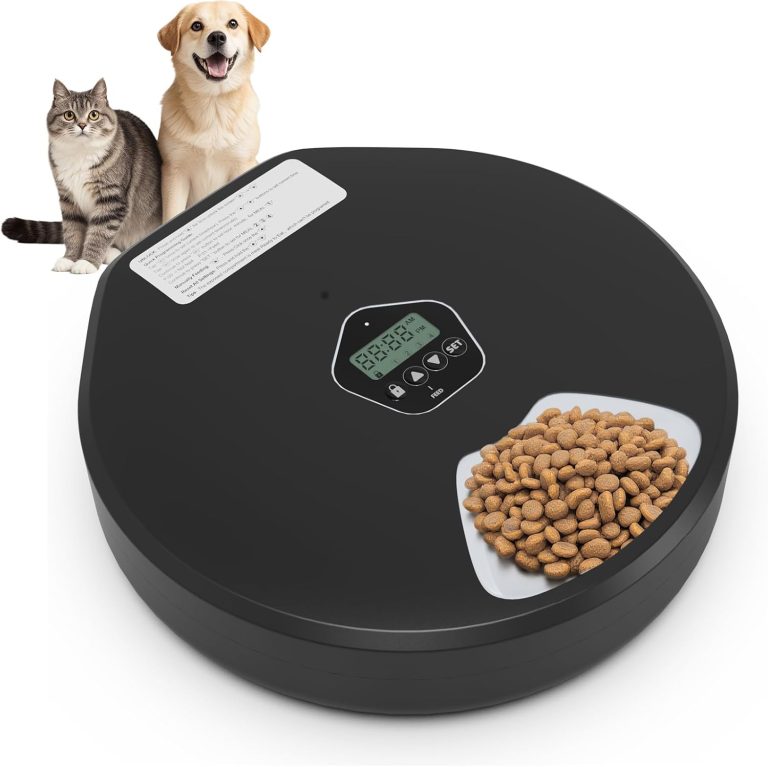
- Basic rotating tray feeders — find at $30-60, run on 4 D cells for 6+ months
Best USB-C Rechargeable Models
- PETKIT Fresh Element Solo ($130-160) — 60-day standby, 1g precision
- Catit Pixi ($70-90) — 30-day charge, stainless bowl
- WOPET Camera Feeder ($80-100) — built-in camera, USB-C rechargeable