Best Automatic Cat Feeders for Prescription Diet 2026: Compatible Feeders for Hills, Royal Canin and Purina Pro Plan
If your cat has a chronic condition — kidney disease, diabetes, urinary issues, hyperthyroidism — the vet has probably put them on a prescription diet. Hills Prescription Diet, Royal Canin Veterinary, and Purina Pro Plan Veterinary Diets are expensive, precisely formulated foods. The wrong feeder can waste that food, throw off portion measurements, or let another cat eat the expensive meal you meant for the one who needs it.
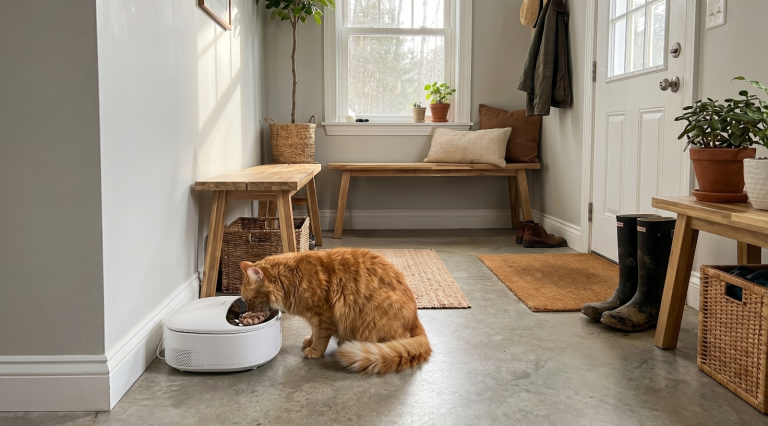
This guide covers feeders that handle prescription diets correctly: accurate portioning, sealed storage, easy cleaning, and — for multi-cat homes — selective access so only the right cat eats the right food.
Why prescription diets need a different feeder
Prescription diets are more expensive and more precisely formulated than over-the-counter food. A feeder that works fine for generic kibble can cause real problems with Rx diets:
- Portion precision matters. A diabetic cat needs exact portions at exact times. Cheap feeders that vary ±15% per serving can disrupt insulin timing.
- Cross-contamination risks. In a multi-cat home, the healthy cat eating the prescription food is wasteful. Worse — a cat on a restricted diet getting extra food undermines the treatment plan.
- Bowl material affects safety. Some plastics harbor bacteria that can contaminate medicated food. Stainless steel or ceramic is the standard for veterinary-recommended feeding.
- Cleaning protocols are stricter. Prescription food residue can degrade bowl surfaces over time. Removable, dishwasher-safe parts are not a luxury — they’re a maintenance requirement.
What to look for in a prescription diet feeder
| Feature | Why it matters for Rx diets |
|---|---|
| Portion accuracy (±5% or better) | Critical for insulin-dependent diabetics and weight management diets |
| Microchip/RFID selective access | Prevents food stealing in multi-cat Rx households |
| Stainless steel or ceramic bowl | Non-porous, bacteria-resistant, easy to sanitize |
| Sealed kibble storage | Preserves prescription food freshness and prevents humidity damage |
| Removable, dishwasher-safe parts | Makes daily cleaning practical, not a chore |
| Battery backup | Ensures feeding schedule isn’t missed during power outages |
| Programmable multiple meals per day | Supports split feeding schedules common in prescription diet plans |
Best Automatic Cat Feeders for Prescription Diet — Reviewed
1. SureFeed Microchip Pet Feeder — Best for Rx Diet Separation
SureFeed is the gold standard for prescription diet management in multi-cat homes. The lid only opens for the cat wearing the matching microchip or RFID collar tag.
Key specs:
– Selective access: Microchip or RFID collar tag (included)
– Bowl material: Stainless steel (included)
– Portions: 1–99 per meal, programmable
– Capacity: Holds one wet or dry meal per cycle
– Battery: 4 C-cell batteries (included), lasts ~6 months
– Cleaning: Bowl and lid are dishwasher safe
Why it works for prescription diets:
The microchip gate is the main event. In a multi-cat home where one cat needs Hills Prescription Diet k/d and the other eats regular food, SureFeed guarantees the right cat eats the right meal. The stainless steel bowl is bacteria-resistant and easy to sanitize between feedings — important for cats on immunosuppressants or with chronic UTIs.
The downside: it’s a single-meal feeder. You set portion size per meal, but the hopper doesn’t hold bulk kibble. For cats needing 3–4 small meals a day of prescription food, you fill it per meal or per day.
Best for: Multi-cat households where one cat needs a strict prescription diet. Also ideal for post-surgery recovery where you need to control exactly when and how much the recovering cat eats.
Price: ~$150–$170
2. PETLIBRO RFID Cat Feeder — Best for Portion Precision
PETLIBRO’s RFID feeder has app-controlled portioning down to the gram, with selective access via RFID collar tags.
Key specs:
– Selective access: RFID collar tags (2 included, up to 10 supported)
– Bowl material: Stainless steel
– Portions: 1–50 portions per meal, ±2g accuracy
– Capacity: 3L hopper (holds ~1.2kg of kibble)
– App: PETLIBRO app with scheduling, portion tracking, feeding history
– Battery: 3 D-cell batteries + USB power adapter
– Cleaning: Removable stainless steel bowl, hopper is top-rack dishwasher safe
Why it works for prescription diets:
Few automatic feeders match the ±2g portion accuracy of PETLIBRO. For diabetic cats on insulin, this level of precision matters — a 5g variance in a 30g meal is a 17% error that can affect blood glucose levels.
The RFID tags work for cats that don’t have a microchip or whose microchip operates at a different frequency. The app tracks how much each cat ate and when — useful data to share with your vet.
The 3L hopper means you can load a few days’ worth of prescription kibble at once, unlike the single-meal SureFeed.
Best for: Cats needing precise portions — diabetic cats, cats on weight-loss prescription diets, or any Rx diet where gram-level accuracy matters.
Price: ~$100–$130
3. PetSafe Smart Feed — Best for Programmable Scheduling
PetSafe Smart Feed is a Wi-Fi connected feeder with flexible scheduling and a straightforward app. It doesn’t do selective access, but it excels at portion and schedule customization.
Key specs:
– Selective access: No
– Bowl material: Stainless steel (included)
– Portions: 1–12 portions per meal in ½-portion increments
– Capacity: 5.5L hopper (large capacity)
– App: PetSafe app with scheduling, portion control, voice recording
– Battery: Backup battery compartment (optional)
– Cleaning: Hopper and bowl are top-rack dishwasher safe
Why it works for prescription diets:
The scheduling flexibility is the standout feature. You can program up to 12 meals per day — useful for cats on a 4–6 meal split feeding schedule common with prescription diet plans. The ½-portion increments allow fine-tuning of meal sizes.
No selective access means this is best for single-cat households, or multi-cat homes where all cats are on the same prescription diet. The large 5.5L hopper means fewer refills. The stainless steel bowl is replaceable and dishwasher safe.
Best for: Single-cat households on prescription diets that need multiple small meals per day. Also good for owners who want app-based tracking of feeding history.
Price: ~$80–$100
4. Cat Mate C5000 — Best Budget Option for Rx Wet Food
The Cat Mate C5000 is a five-compartment wet food feeder with an ice pack, designed for prescription wet food that needs cooling.
Key specs:
– Selective access: No (single lid opens on timer)
– Bowl material: Plastic compartments with optional stainless steel bowls
– Portions: Fixed compartment sizes (5 compartments)
– Capacity: 5 meals per cycle
– Battery: 2 D-cell batteries
– Cleaning: Compartments and lid are dishwasher safe
Why it works for prescription diets:
Many prescription diets come in wet food form — Hills Prescription Diet a/d for recovery, Royal Canin Veterinary Recovery, or Purina Pro Plan Veterinary EN. The C5000’s ice pack keeps wet food fresh for up to 12 hours.
The five-compartment design works well for a split-feeding schedule: load the day’s 4–5 meals at once. The timer rotates to the next compartment at each scheduled feeding time.
The plastic compartments are a weak point — upgrade to the optional stainless steel bowls for better hygiene. No portion control beyond compartment size, so this works best for standard meal sizes.
Best for: Cats on prescription wet food diets, especially during recovery or when the owner needs to pre-load a full day’s meals.
Price: ~$60–$80
5. WOPET Automatic Cat Feeder with Stainless Steel Bowl — Best Value
WOPET’s programmable feeder delivers solid portion control and a stainless steel bowl at a budget-friendly price point.
Key specs:
– Selective access: No
– Bowl material: Stainless steel (included)
– Portions: 1–10 portions per meal
– Capacity: 4L hopper
– Scheduling: Up to 4 meals per day
– Battery: 3 D-cell batteries + USB power
– Cleaning: Removable stainless steel bowl, hopper wipes clean
Why it works for prescription diets:
The stainless steel bowl is the main draw — it’s non-porous and easy to sanitize between uses. The 4L hopper holds a full bag of prescription kibble. Four meals per day programming works for most prescription feeding schedules.
No selective access and only 4 meals per day limit this feeder’s usefulness for complex prescription regimens. Portion control is less precise than PETLIBRO or PetSafe, but adequate for non-diabetic prescription diets.
Best for: Single-cat households on prescription diets where budget is the primary concern and the cat doesn’t need gram-level portion precision.
Price: ~$50–$70
Comparison Table
| Feeder | Selective Access | Bowl Material | Portion Precision | Best For | Price |
|---|---|---|---|---|---|
| SureFeed Microchip | ✅ Microchip/RFID | Stainless steel | Per-meal filling | Multi-cat Rx separation | $$$ |
| PETLIBRO RFID | ✅ RFID collar tags | Stainless steel | ±2g (app controlled) | Precise portions for diabetics | $$ |
| PetSafe Smart Feed | ❌ | Stainless steel | ½-portion increments | Multi-meal scheduling | $$ |
| Cat Mate C5000 | ❌ | Plastic (SS optional) | Fixed compartments | Wet food Rx diets | $ |
| WOPET SS Bowl | ❌ | Stainless steel | ±1 portion | Budget single-cat | $ |
Buying Guide — Choosing a feeder for your cat’s prescription diet
Step 1: Determine if you need selective access
If you have one cat on a prescription diet and another cat eating regular food, you need selective access. SureFeed Microchip and PETLIBRO RFID are your options. Without selective access, the healthy cat will eat the expensive prescription food, and the cat that needs it may not get enough.
If all cats in the household eat the same prescription diet, skip the selective access feature — it adds cost and complexity without benefit.
Step 2: Match portion precision to your cat’s condition
- Diabetic cats: Choose PETLIBRO RFID for ±2g accuracy. Insulin timing depends on consistent food intake.
- Weight management: PetSafe Smart Feed’s ½-portion increments or PETLIBRO’s gram-level control both work.
- Kidney/urinary diets: Standard portion control (±1 portion) is usually sufficient.
- Recovery/post-surgery: SureFeed or Cat Mate C5000 for wet food options.
Step 3: Choose the right bowl material
Stainless steel is the standard for prescription diets. It’s non-porous, doesn’t harbor bacteria, and can be sanitized in the dishwasher. Avoid plastic bowls for any cat on medicated food — plastic can absorb residues and develop scratches that trap bacteria.
If your feeder comes with a plastic bowl (Cat Mate C5000), buy the optional stainless steel replacement.
Step 4: Consider cleaning requirements
Prescription diets leave residue. Look for:
– Removable stainless steel bowls
– Dishwasher-safe parts
– Smooth interior surfaces (no crevices where food can collect)
– Sealed kibble hoppers that don’t let moisture in
Step 5: Plan for power outages
Battery backup is essential for prescription diet feeders. A missed meal for a diabetic cat on insulin can cause hypoglycemia. All feeders listed here have battery backup options, but check the battery life and type before buying.
FAQ
Can I use a regular automatic feeder for prescription diets?
Yes, if the cat is the only one eating from it and the feeder has accurate portion control. The main requirements are stainless steel bowl, dishwasher-safe parts, and precise scheduling. For multi-cat homes, you need selective access.
Will the microchip feeder work with my cat’s existing microchip?
SureFeed reads ISO 11784/11785 microchips (all 125/128kHz and 134.2kHz chips used by US and international shelters). If your cat is already microchipped, test with the feeder before relying on it. PETLIBRO uses RFID collar tags instead, so it works regardless of microchip.
How do I transition my cat from free-feeding to scheduled Rx meals?
Switch gradually over 7–10 days. Start with the same food at the same time the feeder dispenses. Stay nearby for the first few feedings. Most cats adjust within a week. The transition guide on this site has a detailed timeline.
Is it safe to leave prescription wet food in a feeder?
For up to 12 hours with an ice pack (Cat Mate C5000), yes. For longer periods, refrigerate and reload per meal. Do not leave prescription wet food at room temperature for more than 2 hours.
How often should I clean a prescription diet feeder?
Daily. Prescription food residue builds up faster than standard kibble. Remove and wash the bowl after each meal cycle. Wipe the hopper interior weekly. Replace the bowl every 6 months.
Final Verdict
Pick the SureFeed Microchip if you have multiple cats and need to keep one on a strict prescription diet. It’s the only feeder that guarantees the right cat eats the right food.
Pick the PETLIBRO RFID if you need gram-level portion precision — especially for a diabetic cat. The ±2g accuracy and app tracking give you data to share with your vet.
Pick the PetSafe Smart Feed for a single-cat household on a split-feeding schedule. The 12-meal programming and large hopper handle complex prescription regimens.
Pick the Cat Mate C5000 for prescription wet food recovery diets. The ice pack keeps Hills a/d or Royal Canin Recovery fresh through multiple feedings.
Pick the WOPET stainless steel feeder as the budget option — functional, safe, but limited to simple prescription feeding schedules.
Disclosure: As an Amazon Associate, we earn from qualifying purchases. This does not affect our editorial recommendations.