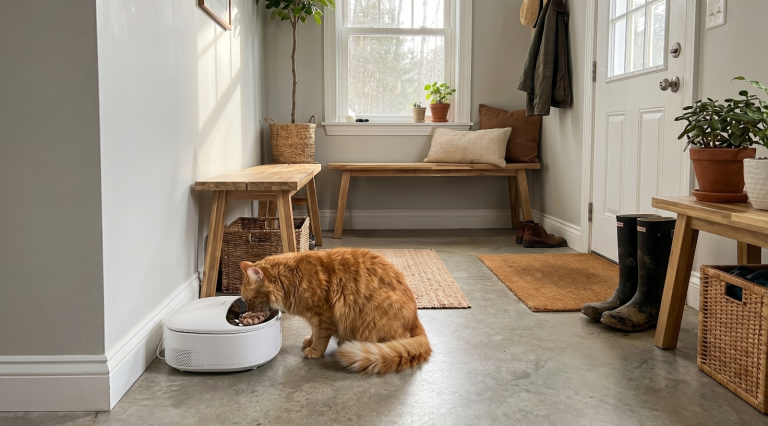
Best Automatic Cat Feeder for Pregnant and Nursing Mother Cats 2026 – Feeding Solutions for Maternity Cats
Best Automatic Cat Feeder for Pregnant and Nursing Mother Cats 2026 – Feeding Solutions for Maternity Cats
A pregnant or nursing cat burns far more calories than a typical adult. During late pregnancy, her requirement jumps 25–50%. Once she starts nursing, it can reach 2–3 times normal. Standard two-meal feeders cannot keep up.
You need a feeder that handles 4–8 small portions daily, keeps portion accuracy at low volumes, and runs quiet enough for a nesting mother and newborn kittens.
Why Pregnant and Nursing Cats Need Special Feeding Schedules
A cat’s pregnancy lasts about 63–65 days. During the first few weeks, her appetite stays normal. Things change around week six. The growing kittens take up space in her abdomen, which means she cannot eat a full meal in one sitting. She needs smaller, more frequent portions throughout the day.
After birth, the energy demands spike further. A nursing mother cat produces milk around the clock. According to veterinary guidelines from the American Association of Feline Practitioners, a nursing queen needs access to food at least four to six times per day. Some mothers eat eight or more small meals daily.
A standard automatic feeder with two or three meal slots will not meet this requirement. You need a unit that supports at least six programmable meals per day and can reliably dispense small portions (as little as one-eighth of a cup) without jamming or over-portioning.
Key Feeder Features for Maternity Cats
Not every automatic feeder works for a pregnant or nursing cat.
4–8 Programmable Meals Per Day
Look for a feeder that supports at least six meal times. Some models cap out at four meals, which leaves gaps in a nursing mother’s schedule. The Cat Mate C5000, for example, supports up to eight meals in a 24-hour cycle. That is the minimum standard for a postpartum queen.
Portion Accuracy at Small Volumes
A nursing mother may only need an eighth to a quarter cup per meal when she is eating six or more times daily. Many auger-based feeders struggle to dispense consistently at these low volumes. Rotating compartment feeders and gravity-fed options tend to perform better here.
Quiet Motor Operation
Newborn kittens are sensitive to noise in their first two weeks. A loud dispensing mechanism can startle the mother or disrupt the nest. Look for feeders that specify low-decibel operation. The PETLIBRO Polar and the Cat Mate C5000 are quieter than average.
Easy-to-Clean Components
Nursing mothers can be messy eaters, and wet food residue builds up fast. Removable bowls, dishwasher-safe parts, and wide openings for hand-washing make daily cleaning practical. Stainless steel bowls are better. They resist bacterial buildup more than plastic.
Battery Backup
A nursing mother cannot wait through a power outage to be fed. A feeder with battery backup ensures meals continue even during an electrical failure. Most WiFi-connected models include this, but double-check before purchasing.
Manual Override
There will be times when you need to add an extra meal because the kittens are cluster-feeding or the mother seems hungry. A manual feed button lets you dispense an additional portion without reprogramming the schedule.
Top 5 Automatic Cat Feeders for Pregnant and Nursing Cats
The table below compares the five feeders that best meet the needs of a maternity cat household.
| Feeder | Meals/Day | Portion Size | Capacity | Noise Level | Battery Backup | Best For |
|---|---|---|---|---|---|---|
| Cat Mate C5000 | Up to 8 | 1/8 cup min | 5 meals (wet/dry) | Low | Yes (D-cell) | Multi-meal wet food schedules |
| PETLIBRO Polar | Up to 6 | 1/8 cup min | 5L dry + ice pack tray | Low | Yes (built-in) | Wet food with cooling |
| SureFeed Microchip | Up to 10 | 1/12 cup min | 2 portions each | Very low | Yes (battery) | Multi-cat with portion control |
| WOPET 6L Camera | Up to 6 | 1/4 cup min | 6L dry | Moderate | Yes (built-in) | Remote monitoring |
| PETKIT Fresh Element | Up to 6 | 1/8 cup min | 5L dry | Low | Yes (built-in) | App-controlled precision |
Cat Mate C5000 — Best Overall for Maternity Feeding
The Cat Mate C5000 is a compartment-based feeder with five separate meal containers. Each container holds up to 4.5 ounces of wet or dry food, and the timer lid opens on a programmed schedule. You can set up to eight meals per day by using the five compartments plus the two large side compartments.
This is the most flexible feeder for a nursing mother because it handles wet food without auger jams or kibble-only restrictions. The compartments keep each meal separate, so you can portion out exact amounts of wet food for each feeding. The motor is quiet enough that it will not disturb a sleeping mother or her kittens.
The trade-off is capacity. At five meals, you will need to refill it daily for a heavy feeder. Check on the mother mid-cycle to ensure she has not emptied a compartment early.
Best for: Owners feeding wet food who need exact portion control across multiple meals.
PETLIBRO Polar — Best for Wet Food With Cooling
The PETLIBRO Polar works with wet food. It uses an ice pack tray to keep food cool between meals, which keeps it from spoiling.
It supports up to six meals per day with adjustable portion sizes as small as one-eighth of a cup. The dispensing mechanism is an auger, so it works best with pâté-style wet food that is not too chunky. Chunks in gravy may clog the opening.
The ice pack keeps food fresh for up to 12 hours, which covers overnight feedings. You will need to swap the ice pack daily.
Best for: Nursing mothers on a wet food diet where spoilage is the main concern.
SureFeed Microchip Feeder — Best for Multi-Cat Homes
If you have multiple cats and only the mother needs special feeding, the SureFeed Microchip feeder is worth considering. It opens only for the microchip or RFID tag it is programmed to recognize. This keeps other cats out of the mother’s food.
The portion control is the most precise of any feeder on this list, down to one-twelfth of a cup. The downside is that the standard bowl holds only two portions, so you will need to refill it multiple times per day for a nursing mother.
The SureFeed is quiet, which makes it a good option if the feeder is placed near the nesting area.
Best for: Multi-cat households where the mother needs exclusive access to her food.
WOPET 6L Camera Feeder — Best for Remote Monitoring
The WOPET 6L Camera feeder includes a built-in 1080p camera with night vision and two-way audio. If you are away from home or the nesting area is in a separate room, you can check on the mother and hear if the kittens are distressed.
It supports up to six meals per day with portions starting at one-quarter cup. The minimum portion is larger than the other feeders on this list, so it works best for mothers who are eating at least a quarter cup per meal.
The motor is louder than the Cat Mate or SureFeed, so place it at least a few feet from the nesting area.
Best for: Owners who want to visually check on the mother and kittens remotely.
PETKIT Fresh Element — Best for App Control
The PETKIT Fresh Element has the smoothest app among the feeders on this list. You can adjust the schedule remotely, dispense extra portions with a tap, and receive notifications when the food is low.
It supports up to six meals per day with portions as small as one-eighth of a cup. The sealed bin includes a desiccant pack to keep dry food fresh, and the stainless steel bowl is easy to clean.
The motor is reasonably quiet, though not as silent as the Cat Mate. The WiFi connection is reliable, but be aware that the feeder falls back to its programmed schedule if the WiFi goes down.
Best for: Owners who want full app control and portion flexibility.
Feeding Schedule Recommendations by Trimester
Early Pregnancy (Weeks 1–4)
The mother does not need extra calories yet. Feed her normal adult maintenance portions on a standard schedule. Continue her regular food. Do not switch to kitten food or high-calorie formulations until week five unless your vet advises otherwise.
Late Pregnancy (Weeks 5–9)
Increase portions gradually. Start adding a third or fourth meal per day. The mother’s abdomen is crowded by growing kittens, so she will eat smaller amounts more frequently. Switch to a high-quality kitten food or all-life-stages formula, which has more protein and fat per calorie.
Aim for 4 meals per day at this stage. Set the feeder to dispense one-eighth to one-quarter cup per meal.
Nursing Period (Birth to 8 Weeks)
Set the feeder to 6–8 meals per day. The mother needs 2–3 times her normal calorie intake. Keep the feeder filled with kitten formula food and provide additional wet food separately if possible.
Monitor her weight weekly. If she is losing condition, add another meal or increase portions. Most nursing queens self-regulate well when food is available frequently.
Weaning Period (4–8 Weeks Post-Birth)
As the kittens start eating solid food (around week four), the mother will naturally nurse less. You can reduce her feeder meals to 4 per day by week six. The kittens may start investigating the mother’s feeder, so a microchip feeder or a separate kitten feeding station helps manage the transition.
Transitioning Kittens to Solid Food With Feeders
Kittens usually start showing interest in solid food around three to four weeks of age. By week eight, they should be fully weaned. Automatic feeders can help manage this transition.
Week 3–4: Introduction
Place a shallow dish of kitten slurry (wet kitten food mixed with kitten formula) near the mother’s feeder. Most kittens will investigate on their own. Do not use the automatic feeder for kittens at this stage. They need direct supervision and fresh food.
Week 5–6: Separate Feeding Station
Set up a separate automatic feeder for the kittens using a basic model like the Cat Mate C5000 with portions sized for kittens. Keep the mother’s feeder separate so she can eat without competition.
Week 7–8: Gradual Independence
Reduce the mother’s meal count to 3–4 per day as the kittens eat more solid food. By week eight, the mother should be back to a normal adult feeding schedule. The kittens can continue on their own feeder until they reach adult portion sizes.
Common Mistakes to Avoid
Relying on a 2-Meal Feeder
The most common mistake is assuming a standard two-meal feeder will work for a nursing mother. A queen cannot eat enough in two sittings to meet her energy needs. She needs frequent small meals. If your feeder cannot do at least six meals, it is not suitable for this purpose.
Ignoring Noise Levels
A feeder that sounds like a coffee grinder can stress a new mother and frighten kittens. Test the feeder’s noise level before placing it near the nesting area. If the motor is loud, move the feeder to the nearest quiet spot and let the mother come to it.
Using the Wrong Bowl Material
Plastic bowls develop scratches that trap bacteria. Nursing mothers have heightened susceptibility to bacterial infections, especially if they are stressed or recovering from birth. Use stainless steel or ceramic bowls only.
Forgetting Battery Backup
A nursing mother’s feeding schedule cannot pause for a power outage. If you choose a plug-in feeder, verify that it has a battery backup that actually works without WiFi. Test it before the kittens arrive.
Setting and Forgetting
No automatic feeder works as a set it and forget it device for a nursing mother. Check on her twice daily. Make sure she is eating, the feeder is dispensing correctly, and the food has not spoiled. A mother who stops eating needs veterinary attention within 24 hours.
FAQ Section
How many meals per day should a nursing cat eat?
A nursing mother needs 6–8 small meals per day. Late-pregnancy cats need 4–6 meals. Standard adult maintenance is 2 meals, so plan to increase frequency.
Can I use a wet food feeder for a nursing mother?
Yes. The Cat Mate C5000 and PETLIBRO Polar both handle wet food. The Cat Mate uses separate compartments that keep wet food fresh without refrigeration for up to 12 hours. The Polar uses an ice pack tray for cooling. For a nursing mother, wet food often works better because it adds hydration.
Will the feeder noise scare newborn kittens?
Newborn kittens are most sensitive to noise during their first 10–14 days. Place the feeder at least 3–4 feet from the nesting box. If the feeder is unusually loud (some auger models), move it to a nearby table or dresser rather than the floor.
How do I prevent other cats from eating the mother’s food?
A microchip feeder like the SureFeed is the best solution for multi-cat homes. It opens only for the programmed microchip or RFID tag. Some feeders come with collar tags if the mother is not microchipped.
When should I stop using the maternity feeding schedule?
Start reducing meals around week 6–7 after birth, when the kittens begin eating solid food consistently. By week 8, most mothers can return to a normal adult feeding schedule (2–3 meals per day). If the mother is still nursing heavily at week 8, consult your veterinarian.
Can I use a gravity feeder for a nursing mother?
Gravity feeders continuously refill the bowl, which means you cannot control portion sizes or track how much the mother is eating. This makes it difficult to know if she is eating enough. Use a programmable feeder instead.
This guide is based on veterinary feeding guidelines for feline pregnancy and lactation. Always consult your veterinarian before making significant changes to your cat’s diet, especially during pregnancy and nursing.
Products mentioned: Cat Mate C5000, PETLIBRO Polar, SureFeed Microchip Feeder, WOPET 6L Camera Feeder, PETKIT Fresh Element Infinity