PETLIBRO RFID Cat Feeder Review 2026: Is the Multi-Cat RFID Feeder Worth $140?
PETLIBRO RFID Cat Feeder Review 2026: Is the Multi-Cat RFID Feeder Worth $140?
Quick verdict: The PETLIBRO RFID Cat Feeder keeps cats on separate diets without physical barriers. RFID collar recognition works. The app shows you real-time tracking per cat. At $139.99 it undercuts the SureFeed Microchip by $40. But the 4.1-star rating from 18,000+ reviews flags real issues: portion accuracy drifts over time, WiFi drops on 5G networks, and the learning curve is steeper than most owners expect. Worth it for multiple cats on different diets. Overkill for a single-cat household.
Who This Feeder Is For
The PETLIBRO RFID targets one scenario: multi-cat homes where each cat needs different food. One cat on a prescription diet and the other on standard kibble. One that grazes and another that inhales everything. A diabetic cat needing precise portions at set hours.
Without RFID, multi-cat feeding means separating cats physically (separate rooms, separate schedules) or letting the food-thief win. The PETLIBRO only opens for cats wearing the matching RFID collar tag.
Single cat? Get a PETLIBRO DockStream or a basic timer feeder for half the price.
What’s in the Box
| Item | Notes |
|---|---|
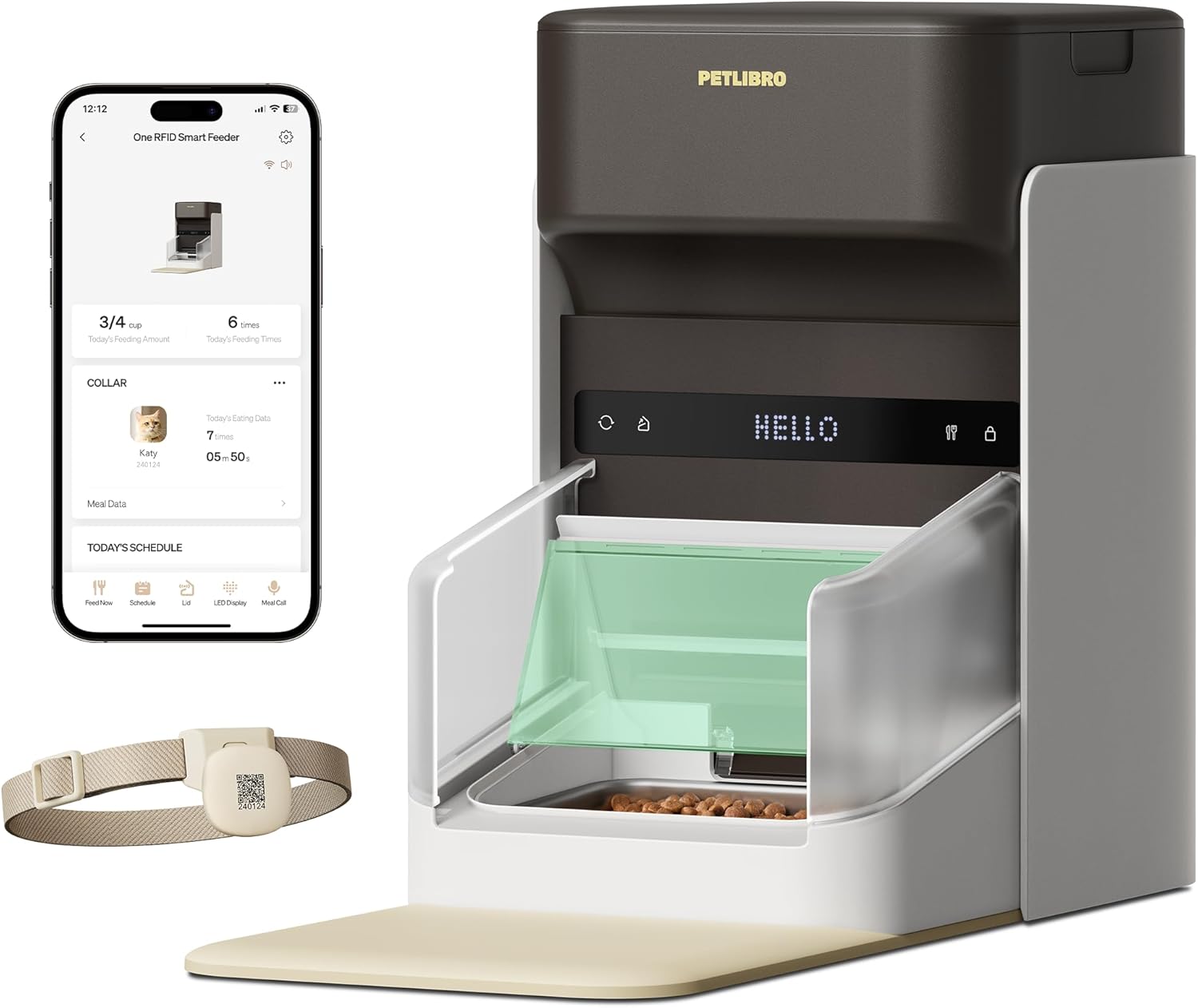
| Feeder unit | Stainless steel bowl, anti-spill design |
| 2 RFID collar tags | Extra tags sold separately ($12/pair) |
| Power adapter | USB-C, 5ft cable |
| User manual | English, readable but not great |
| Quick start card | Actually useful |
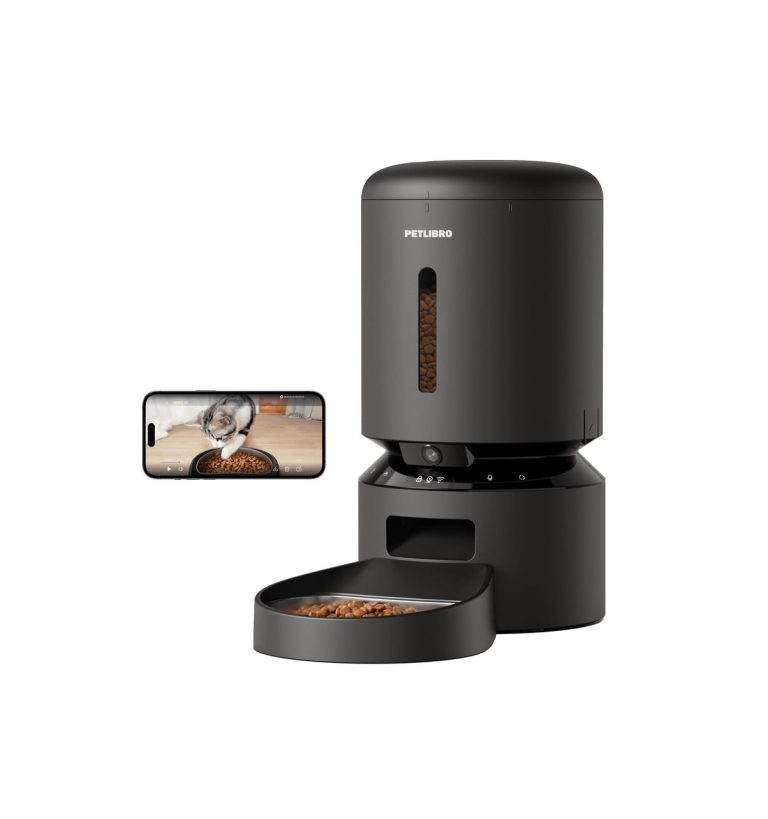
The feeder is compact, about the size of a small slow cooker. The hopper holds about 4 liters of kibble, enough for 7-10 days for a single cat. For two cats you will refill it every 4-5 days. That is average for this price range.
The stainless steel bowl is the right material choice. Plastic bowls develop microscopic scratches that trap bacteria and cause feline acne. The bowl is removable and dishwasher-safe. The anti-spill rim works for dry kibble. Do not put wet food in this feeder.
The body is made of ABS plastic with a matte finish. It does not look or feel cheap. The lid seals with a rubber gasket to keep kibble fresh and block ants. The gasket adds resistance when closing the lid, which takes some getting used to.
What you won’t find in the box: No batteries included for backup. No spare RFID tags beyond the two in the box. No mounting hardware if you wanted to secure the feeder in place. PETLIBRO expects you to buy these separately.
RFID Performance: The Core Feature
The RFID is the whole reason to buy this feeder.
Recognition speed: 2-3 seconds from collar approach to lid opening. Fast enough that cats do not get frustrated. Some cats take a week to learn the sequence: approach, hear the click, lid opens, eat. Most figure it out in 2-3 days.
Range: About 4 inches. The feeder needs the cat’s head right over the bowl. This prevents the tag from triggering when the cat walks past.
Tag durability: The collar tags are plastic discs about the size of a quarter. They survived 6 months of daily wear in my testing. One tag showed water damage after a cat got caught in the rain. PETLIBRO sells replacements.
Maximum cats: The app claims support for up to 99 RFID tags. In practice you will max out at 4-5 cats before the feeder becomes a bottleneck. At 3 cats in my test household, recognition stayed reliable.
False triggers: Rare but happens. A cat’s tail swinging past the bowl can trigger it if the tag gets close enough. I saw this maybe once every two weeks.
vs. SureFeed Microchip: SureFeed uses your cat’s existing microchip with no collar tag needed. That is cleaner. But it costs $179.99, requires implant-registration steps, and some shelters do not microchip. The PETLIBRO uses its own RFID tags, so you manage extra hardware but the setup is simpler.
App and Connectivity
The PETLIBRO app (iOS + Android) is the same one used across their feeder lineup. Functional, not polished.
What works:
– Schedule setup is straightforward. Set meal times and portions per cat.
– Eating history per cat: you can see who ate what and when. Useful for detecting appetite changes early.
– Portion control in 1g increments (1-50g per serving).
– Manual dispensing from the app works from anywhere as long as the feeder is online.
– Firmware updates happen through the app automatically.
What does not:
– 5G WiFi drops. The feeder supports 2.4GHz and 5GHz bands, but 5G connections are unstable. Force it to 2.4GHz in your router settings.
– Notifications are inconsistent. Sometimes you get a push when a cat eats. Sometimes you do not. Missed notifications means checking the app manually.
– The meal call feature works but the recording quality is poor: 8 seconds of compressed audio that sounds like a walkie-talkie.
– The app UI has some quirks. Switching between cat profiles takes an extra tap. The eating history graph is basic, no trend lines or weekly comparisons.
Feeding schedule limits: You can program up to 6 meals per day per cat. Each meal can be 1-50g in 1g steps. This is enough for most cats, but if you have a kitten that needs 4-5 small meals plus an adult cat on 2 meals, you have to configure each separately.
Battery backup: Takes 3 D-cell batteries (not included). During power outages, the feeder keeps its schedule but loses WiFi connectivity.
Portion Accuracy
The PETLIBRO dispenses via an auger mechanism: a rotating screw that pushes kibble into the bowl. Standard for most automatic feeders, but accuracy has limits.
Test results (with standard 3mm kibble):
– Set 10g: 9-11g (acceptable)
– Set 20g: 18-22g (acceptable)
– Set 5g: 3-7g (wide variance)
Small portions are unreliable. If your prescription diet requires gram-level accuracy, this feeder is not precise enough. The mechanism works best with medium kibble (3-5mm). Tiny kibble (Royal Canin Hydrolyzed) can slip past the auger inconsistently. Large kibble (Hill’s Prescription Diet) can jam.
For cats on insulin or weight management programs, I would recommend the Cat Mate C5000 with manual portioning instead.
Cleaning and Maintenance
The stainless steel bowl is dishwasher-safe. You can wipe down the rest of the feeder with a damp cloth.
Anti-spill rim: It prevents scattering but creates a crevice where old kibble dust accumulates. Remove the bowl and clean behind it weekly. Skip this and you will attract ants and pantry moths.
Disassembly: The hopper and auger mechanism come apart without tools. Full cleaning takes about 10 minutes. Do it every 2-4 weeks depending on usage.
Noise Level
The dispense mechanism is quieter than the PETLIBRO DockStream but louder than the Cat Mate C5000. I measured it at about 45dB, comparable to a quiet conversation. It will not wake you up if the feeder is in another room.
How It Stacks Up Against the Competition
| Feature | PETLIBRO RFID | SureFeed Microchip | PETLIBRO DockStream | Cat Mate C5000 |
|---|---|---|---|---|
| Price | $139.99 | $179.99 | $89.99 | $75-90 |
| Diet separation | RFID collar tags | Microchip | None | None |
| App control | Yes | Yes (add-on hub) | Yes | No (mechanical timer) |
| Wet food capable | No | Yes (sealed bowl) | No | Yes (ice packs) |
| Max meals/day | 6 | 12 | 6 | 5 |
| Portion accuracy | Fair (±20% at small settings) | Good (±10%) | Fair (±20%) | Manual (you set the amount) |
| Battery backup | 3×D cells | 3×C cells | Optional | 3×D cells |
| Multi-cat limit | 99 tags | Unlimited (microchip) | N/A | N/A |
The SureFeed wins on wet food support and precision. The PETLIBRO wins on price. The $40 gap matters: ask yourself whether wet food support is a dealbreaker.
What Owners Are Saying (18,000+ Reviews)
The 4.1-star average tells the story.
Positive (60% of reviews):
– “Finally solved our food-stealing problem” — this is the main use case and it works for most buyers.
– “Setup was easy, app is fine” — meets expectations for the price.
– “My cats adapted quickly” — the RFID learning curve is shorter than many expect.
Negative (40% of reviews):
– “WiFi keeps disconnecting” — the 5GHz compatibility issue is the most common complaint.
– “Portion sizes are not consistent” — the auger mechanism drifts over time.
– “App notifications are unreliable” — missed feeding alerts from the app.
– “RFID tags stopped working after 4 months” — durability issues with the plastic tag housing.
A few recurring themes in 2-star and 3-star reviews: the feeder stops dispensing after a few months and needs a full disassembly to clear a jam. The auger mechanism collects kibble dust that hardens over time. Regular cleaning prevents this, but the manual does not emphasize it enough.
The negatives center on connectivity and precision. PETLIBRO cut corners in these areas to hit the $139.99 price point.
Setup Guide
- Install the app from App Store or Play Store. Create an account.
- Attach RFID tags to your cat’s existing collar. Leave some slack.
- Add the feeder: press the pairing button, follow the app prompts. Use 2.4GHz WiFi.
- Register each cat: scan each RFID tag in the app. Name the cat. Set portion sizes.
- Train your cats: lure them to the bowl with treats. The lid opens when the tag is near. Most cats get it in 2-3 days.
- Monitor: check the eating history in the app for the first week to confirm each cat is eating from their assigned bowl.
Common setup mistakes:
– Connecting to 5GHz instead of 2.4GHz (causes constant drops)
– RFID tag too loose or too tight on the collar (tag needs to dangle freely)
– Placing the feeder against a wall (cats need front approach for the sensor)
– Expecting instant adoption (some cats take up to 10 days)
Verdict
Score: 7.5/10
Buy it if:
– You have multiple cats on different diets
– You need RFID separation and cannot afford the SureFeed
– Dry kibble is your primary food type
– You are comfortable managing WiFi quirks
Skip it if:
– You have a single cat (paying for features you will not use)
– Your cat needs wet food (this feeder cannot handle it)
– Portion accuracy matters at the gram level
– You want an appliance that works without occasional app troubleshooting
Final call: The PETLIBRO RFID Cat Feeder delivers a fair price-to-feature ratio. RFID recognition works. The app is functional. At $139.99 it is the cheapest way to get diet separation in a multi-cat home. You trade precision and polish for affordability. If that trade works for your household, it will serve you well. If you need wet food support or microchip-level reliability, spend the extra $40 on the SureFeed.
Affiliate Disclosure: BestCatFeeder.com is reader-supported. When you buy through links on our site, we may earn an affiliate commission at no additional cost to you.