PETKIT Fresh Element Solo vs YumShare Daily Feast 2026: Camera Feeder or Rotating Multi-Bowl — Which PETKIT Model Fits Your Cat?
Introduction
|You’re shopping PETKIT and bouncing between two models: the Fresh Element Solo (camera feeder, $99.99) and the YumShare Daily Feast (rotating dual-bowl, $159.99). Same brand, different approaches to feeding your cat.
One gives you eyes on your cat while you are away. The other gives you multi-cat separation and six-meal rotation. Which one fits your household?
We compare camera quality, portion flexibility, multi-cat support, app reliability, cleaning ease, and price value.
At a Glance: Fresh Element Solo vs YumShare Daily Feast
| Feature | Fresh Element Solo | YumShare Daily Feast |
|---|---|---|
| Price | $99.99 | $159.99 |
| Bowls | 1 (stainless steel) | 2 rotating (stainless steel) |
| Camera | 1080P with night vision | None |
| Multi-cat support | No | RFID pet tag recognition |
| Meals per day | Up to 4 | Up to 6 |
| Portion sizes | 1-8 portions per meal | 1-5 portions per meal |
| Connectivity | 2.4G WiFi | 2.4G WiFi |
| App control | Yes | Yes |
| Motion alerts | Yes | No |
| Manual feeding | Via app | Via app + button |
| Power backup | Battery option (D-cell) | Battery option (D-cell) |
| Capacity | ~3L dry food | ~4L total (2L per bowl) |
| Dimensions | Compact, single-bowl footprint | Wider, dual-bowl footprint |
| Best for | Single-cat households that want monitoring | Multi-cat households with separate diet needs |
Fresh Element Solo: Camera Monitoring and Portion Precision
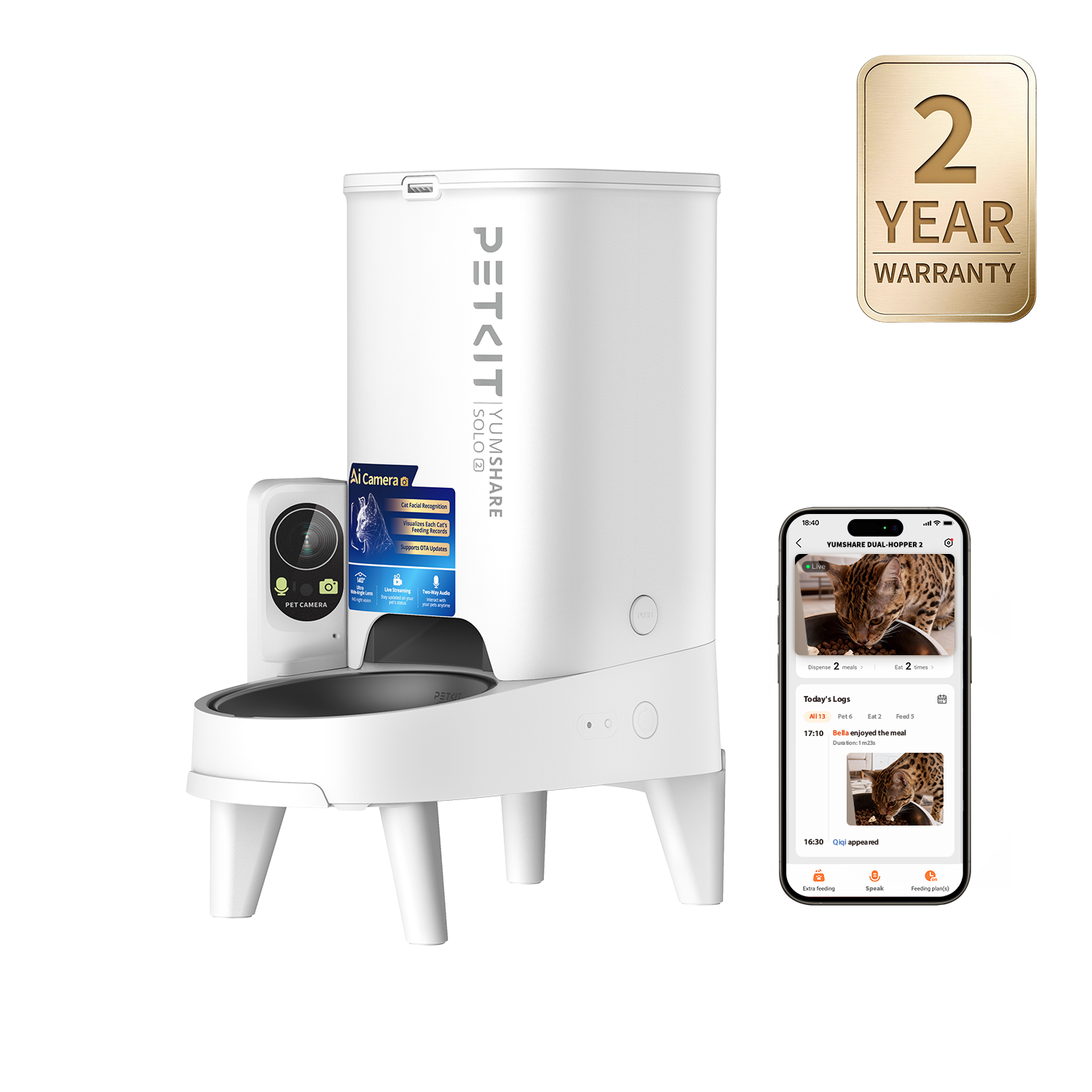
The Fresh Element Solo is PETKIT’s answer to the “I want to see my cat eat” crowd. Its headline feature is a 1080P camera with night vision that streams live video to the PETKIT app. You can check in on your cat during meals, see if they are eating (not just sniffing and walking away), and get motion alerts when your cat approaches the feeder.
What it does well
Camera quality. The 1080P stream is usable, not the grainy stuttery mess you get from cheaper camera feeders. Night vision is clear enough to see your cat’s face and whether the bowl is empty. Two-way audio lets you talk to your cat remotely, which some owners use for recall training.
Portion control. The Solo delivers 1-8 portions per meal, up to 4 meals per day. Each portion is about 10g of kibble, so you are looking at 10-80g per meal. That covers most single-cat feeding schedules: breakfast, lunch, dinner, and a late snack if your cat is a grazer.
Cleaning. Single stainless steel bowl, single food hopper. Disassembly is straightforward: the bowl comes out, the lid pops off, and the auger mechanism is exposed enough to brush clean. Fewer parts means less chance of missing a crevice where old food builds up.
App experience. PETKIT’s app is one of the better ones in the smart feeder space. Scheduling is intuitive (tap to set meal times, slide to adjust portions), the live feed loads in about 2 seconds on WiFi, and notifications actually push through on iOS and Android.
Where it falls short
No multi-cat support. The Solo cannot distinguish between cats. If you have two cats and one is on a prescription diet, the Solo is not the answer. It dispenses food, any cat can eat it.
Single bowl, single food type. One hopper means one food. You cannot mix kibble types or offer wet food alongside dry. If your cat needs a mixed diet, you need a second feeder or manual supplementation.
Plastic food hopper. The hopper is transparent plastic, which scratches over time. Scratches trap bacteria and oils. It’s not as durable as the stainless steel interior options on some competitors, though at $99.99 that’s an expected trade-off.
4 meals per day cap. Cats with medical needs (IBD, diabetes, post-surgery recovery) often need 5-6 small meals daily. The Solo’s four-meal limit may not be enough for prescription feeding schedules.
Who it’s for: Single-cat owners who want to check in remotely, see their cat eating, and get notifications when feeding happens. Especially useful for owners who travel or work long hours and worry about whether their cat is eating normally.
YumShare Daily Feast: Rotating Dual-Bowl for Multi-Cat Households
The YumShare Daily Feast takes a different approach. Instead of a camera, it gives you two rotating stainless steel bowls, each with its own food supply, identified by RFID pet tags worn on your cat’s collar. The bowls rotate into position based on which cat approaches.
What it does well
True multi-cat separation. Each cat wears a lightweight RFID tag on their collar. When the tagged cat approaches, the feeder rotates the correct bowl into position. Cat A gets their prescription kidney diet, Cat B gets their weight management kibble, Cat C gets kitten food. No food stealing, no diet cross-contamination.
Six meals per day, two bowls. Each bowl can be programmed independently for up to 3 meals (6 total across both bowls). This matters for households where one cat eats 4 small meals and the other eats 2 larger meals.
Portion flexibility per cat. You set portions per cat, not per bowl. Cat A gets 3 portions at breakfast, Cat B gets 5. The feeder tracks which bowl goes to which cat and dispenses accordingly.
Stainless steel throughout. Both bowls are stainless steel, no plastic scratching or bacterial buildup in scratches. The food hoppers are still plastic, but the contact surface for your cat’s food is metal.
Larger total capacity. At 4L total (2L per bowl), you can run the YumShare longer between refills than the Solo, especially if both cats are eating at different rates.
Where it falls short
No camera. This is the biggest trade-off. If you want to see your cat eating remotely, the YumShare cannot do that. You get feeding logs and notifications (“Cat A ate at 8:02 AM”), but no video feed.
RFID tags are easy to lose. The tags attach to the collar. Cats that go outside, play rough, or get into fights can lose the tag. You’ll need spares. The feeder defaults to not dispensing if an untagged cat approaches, so a lost tag means a missed meal.
Larger footprint. The rotating mechanism and dual bowls make the YumShare wider than the Solo. It takes up more counter space. If your feeding station is tight, measure first.
More parts to clean. Two bowls, two hoppers, a rotating mechanism with moving parts. Disassembly and cleaning takes longer than the Solo. Food debris can get into the rotation track if you’re not thorough.
Price. At $159.99, it’s $60 more than the Solo. The RFID hardware and rotating mechanism add cost. For a single-cat household, that extra spend doesn’t buy you anything useful.
Who it’s for: Multi-cat households where cats eat different food. If you have one cat on a vet-prescribed diet and another eating regular kibble, the YumShare is the only PETKIT model that handles this scenario without constant supervision.
App Comparison: Same Foundation, Different Controls
Both feeders use the same PETKIT app (available on iOS and Android). The app interface is nearly identical. You add the feeder, set schedules, and monitor feeding logs. The differences come down to what each feeder’s hardware enables.
| App Feature | Fresh Element Solo | YumShare Daily Feast |
|---|---|---|
| Live video stream | Yes | No |
| Motion alerts | Yes | No |
| Two-way audio | Yes | No |
| Per-cat feeding logs | No | Yes (tag-based) |
| Schedule per bowl | Single schedule | Per-bowl schedule |
| Portion adjustment | Per meal | Per cat per meal |
| Manual feeding | App button | App button |
If you compare the app experience in a vacuum, the Solo’s app feels richer because of the camera features. But the YumShare’s app is actually doing more complex work, tracking which cat ate what and when. It just does not have a visual component.
Cleaning and Maintenance
PETKIT feeders are better than average on maintenance, but neither model is “set and forget.”
Fresh Element Solo: One bowl, one hopper, one auger. Full clean takes about 10 minutes. The auger mechanism needs occasional disassembly to remove kibble dust buildup. Bowl is dishwasher-safe (top rack). Hopper is hand-wash only.
YumShare Daily Feast: Two bowls, two hoppers, rotating mechanism. Full clean takes about 20 minutes. The rotation track needs attention. Food dust and small kibble fragments can collect in the guide rails. Each bowl is dishwasher-safe. The RFID reader ring should be wiped down but not submerged.
Frequency guide: Dry food only, clean every 2 weeks. Mixed wet/dry, clean weekly. In a humid environment, clean weekly regardless to prevent clumping in the hopper.
Which PETKIT Feeder Should You Buy?
This is not a “one is better” comparison. These two feeders serve different households.
Buy the Fresh Element Solo if:
– You have one cat
– You want remote monitoring and video check-ins
– You travel or work long hours
– Your cat eats one type of food
– You’re on a $100ish budget
– Your feeding schedule fits within 4 meals per day
Buy the YumShare Daily Feast if:
– You have 2+ cats
– Your cats eat different food (prescription diet, weight management, kitten vs adult)
– Food stealing is a problem in your household
– You need 5-6 small meals per day for at least one cat
– You’re willing to manage RFID tags on collars
– Your budget stretches to $160
Buy both if:
– You have multiple cats on different diets AND want camera monitoring for one feeding station. Use the YumShare for the multi-cat controlled feeding and the Solo for a secondary station with video.
FAQ
Can I use the YumShare without RFID tags?
No. The YumShare relies on RFID tags to determine which bowl to rotate. Without a tag, the feeder defaults to a “no cat detected” state and will not dispense.
Does the Fresh Element Solo work with wet food?
The Solo is designed for dry kibble only. The single-bowl dispenser cannot portion wet food accurately, and wet food left in the hopper will spoil.
How long do the RFID tags last?
The tags are passive (no battery) and typically last 2-3 years with normal use. They’re water-resistant but not waterproof. Replace if the cat loses the tag or if it stops being read by the feeder.
Can I connect both feeders to one app account?
Yes. The PETKIT app supports multiple devices. You can control a Solo and a YumShare from the same account.
Does either feeder have a manual feed button?
The YumShare has a physical button on the unit for manual dispensing. The Solo relies on the app for manual feeding, which means you need your phone and an active connection.
What happens during a power outage?
Both feeders accept D-cell batteries as backup. The battery compartment keeps the scheduled meals running during outages, but the Solo’s camera features require WiFi and will not work on battery alone.
Verdict
The Fresh Element Solo is the right PETKIT feeder for single-cat owners who want camera monitoring. The YumShare Daily Feast is the right choice for multi-cat households managing separate diets.
The decision comes down to one question: do your cats eat the same food or different food? Same food, get the Solo. Different food, get the YumShare.