Eco-Friendly and Sustainable Automatic Cat Feeders 2026: Bamboo Finishes, Recycled Materials, and Energy-Saving Options Compared
Category: Cat Feeder Reviews
As an Amazon Associate, we may earn commissions from qualifying purchases. This does not affect the accuracy of our recommendations.
Eco-Friendly and Sustainable Automatic Cat Feeders 2026: Bamboo Finishes, Recycled Materials, and Energy-Saving Options Compared
Most automatic cat feeders are plastic, run on disposable batteries, and get replaced every two years. A growing number of owners want something different: feeders made with sustainable materials, lower energy consumption, and longer lifespans.
This covers the eco-friendly options available in 2026, what sustainability actually means for automatic feeders, and which brands are making real progress vs greenwashing.
What Makes a Feeder Eco-Friendly?
Four factors determine the environmental impact of an automatic cat feeder:
- **Materials**: Is the body made from recycled plastics, bamboo, or wood? Or virgin ABS plastic that never biodegrades?
- **Energy consumption**: USB-C rechargeable models draw less power over their lifetime than models running on disposable AA batteries (which create hazardous waste).
- **Repairability**: Can you replace individual parts, or does a broken timer motor mean throwing away the whole unit?
- **Packaging**: Is the box made from recycled cardboard with minimal plastic, or wrapped in foam and individual plastic bags?
Feeder Sustainability Ratings
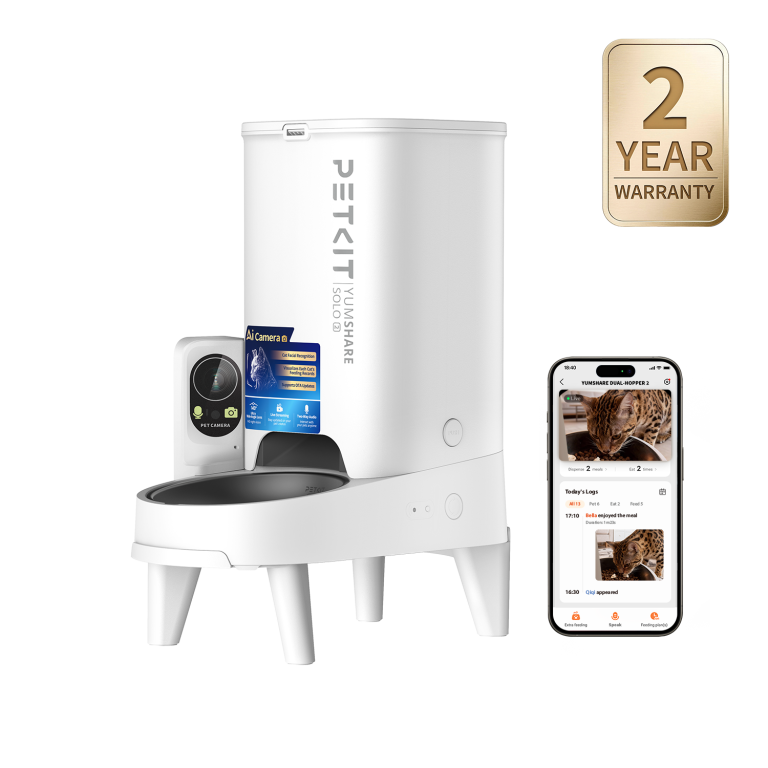
PETKIT Fresh Element
| Factor | Rating | Details |
|---|---|---|
| ——– | ——– | ——— |
| Materials | 7/10 | Recyclable plastics, stainless steel bowl |
| Energy | 9/10 | USB-C rechargeable, low power draw |
| Repairability | 6/10 | Modular but limited part availability |
| Packaging | 8/10 | Recycled cardboard, minimal plastic |
| **Overall** | **7.5/10** |
PETKIT scores well on energy thanks to USB-C charging. One charge runs for 3-4 weeks at normal use, which over a year means less battery waste than AA-powered feeders. The packaging uses recycled cardboard with minimal plastic inserts.
The main downside is repairability. The electronics are sealed, and individual parts (motor, control board, bowl) are not sold separately in most markets. When the USB-C port fails, most owners replace the entire unit.
Cat Mate C5000
| Factor | Rating | Details |
|---|---|---|
| ——– | ——– | ——— |
| Materials | 8/10 | Durable ABS, stainless steel, fewer electronic components |
| Energy | 8/10 | AC + AA backup, mechanical timer |
| Repairability | 9/10 | Fully repairable, parts available |
| Packaging | 7/10 | Standard cardboard packaging |
| **Overall** | **8.0/10** |
The C5000 is the most sustainable option by lifespan. It is mechanical not electronic. The timer is a simple motor and gear system. When something breaks, you can buy replacement parts: timer mechanisms, compartment trays, ice pack holders.
A Cat Mate C5000 typically lasts 5-8 years with normal use, compared to 2-4 years for app-controlled smart feeders. The longer lifespan means less electronic waste per year of use.
The mechanical timer draws power only when rotating between compartments, which is about 30 seconds per rotation. Most of the time, it sits idle using no power at all.
PETLIBRO DockStream
| Factor | Rating | Details |
|---|---|---|
| ——– | ——– | ——— |
| Materials | 6/10 | ABS plastic body, stainless steel bowl |
| Energy | 6/10 | Always-on WiFi + camera module draws constant power |
| Repairability | 4/10 | Sealed unit, no part replacement |
| Packaging | 7/10 | Recycled cardboard |
| **Overall** | **5.8/10** |
The DockStream has the highest energy draw of any feeder in this comparison because the WiFi module and camera run continuously. Over a year, the power consumption is roughly 3-4x that of a PETKIT Fresh Element and 10x that of a Cat Mate C5000.
The camera and electronics are sealed. A failed camera lens or dead WiFi board means replacing the entire unit. No repair options available.
WOPET (Budget Models)
| Factor | Rating | Details |
|---|---|---|
| ——– | ——– | ——— |
| Materials | 4/10 | Thin plastic, lesser build quality |
| Energy | 5/10 | AC + AA backup |
| Repairability | 2/10 | Not repairable, parts unavailable |
| Packaging | 5/10 | Standard packaging |
| **Overall** | **4.0/10** |
WOPET feeders have the shortest average lifespan (1-2 years based on Amazon review analysis). A product that fails and gets replaced frequently has a higher environmental impact than one that lasts 5+ years, even if the initial materials seem similar.
Energy Consumption Comparison
| Feeder | Daily Power Draw | Annual CO2 (est.) | Battery Waste (annual) |
|---|---|---|---|
| ——– | —————– | ——————- | ———————- |
| PETKIT Fresh Element | 0.02 kWh (USB-C) | ~2 kg | 0 AA batteries |
| Cat Mate C5000 | 0.01 kWh | ~1 kg | 4-8 AA batteries |
| PETLIBRO DockStream | 0.08 kWh (always-on WiFi + camera) | ~8 kg | 4-8 AA batteries |
| PetSafe Smart Feed | 0.03 kWh | ~3 kg | 4-8 AA batteries |
| WOPET | 0.03 kWh | ~3 kg | 4-8 AA batteries |
USB-C rechargeable models produce the least battery waste over their lifespan. Mechanical feeders (Cat Mate C5000) produce slightly more battery waste but less total electronic waste because the feeder itself lasts longer.
Sustainable Materials in 2026
Bamboo and wood finishes are appearing on some feeder models, but most of these are cosmetic covers over standard plastic bodies. The sustainability benefit is minimal because the underlying electronics and mechanisms remain the same.
Recycled plastics are more common in 2026 than in previous years. PETKIT uses recycled ABS in some internal components. PETLIBRO and PetSafe use virgin plastics with no recycled content visible in their product specifications.
Stainless steel bowls are the norm across all mid-range and premium feeders, which is a positive change from the plastic bowls common in budget models a few years ago.
Extending Feeder Lifespan
The most sustainable feeder is the one you already own. These maintenance practices extend the life of any automatic feeder:
- **Clean the auger and hopper monthly** to prevent motor strain from caked-on kibble dust.
- **Replace AA batteries before they leak.** Alkaline battery corrosion is the top cause of feeder failure in models with battery backup. Use lithium AA batteries for longer life and lower leak risk.
- **Keep the WiFi camera feeder plugged into a surge protector.** Power surges damage the sensitive electronics in camera feeders.
- **Replace seals and gaskets annually.** The rubber seals that keep moisture out of the hopper degrade over time and let humidity in, causing kibble to stale faster.
- **Store the feeder properly between uses.** If you switch to manual feeding, clean and dry the feeder completely before storing it.
What to Look For
When shopping for an eco-friendly feeder, prioritize:
- **USB-C rechargeable** over AA-only or WiFi-cam models. Lower energy consumption and zero battery waste.
- **Mechanical or simple electronic** over smart-connected. Fewer failure points, longer lifespan, easier to repair.
- **Stainless steel bowl** over plastic. Lasts longer, dishwasher safe, no plastic degradation over time.
- **Available replacement parts** before purchase. If the brand does not sell replacement motors, trays, or bowls, the feeder is disposable by design.
Verdict
No automatic cat feeder is sustainable. Electronics, plastics, and shipping packaging all have environmental costs. But some choices are clearly better than others.
The Cat Mate C5000 has the lowest overall environmental impact. It lasts 5-8 years, its parts are replaceable, and the mechanical timer uses minimal power. The PETKIT Fresh Element is the best option among smart feeders thanks to USB-C charging and lower power requirements.
Always-on WiFi camera feeders are the worst choice for sustainability. High energy consumption. Short lifespan. No repair options. If you need a camera feeder, buy it expecting to replace it every 2-3 years, and plan for that disposal responsibly.