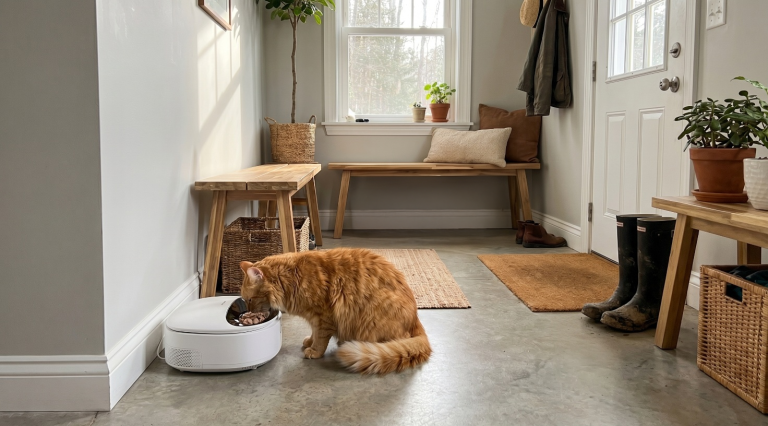
PetSafe Smart Feed Automatic Cat Feeder Review 2026: Smart Feed vs Smart Feed Simple
PetSafe Smart Feed Automatic Cat Feeder Review 2026: Smart Feed vs Smart Feed Simple
PetSafe Smart Feed vs Smart Feed Simple: At a Glance
| Feature | Smart Feed | Smart Feed Simple |
|---|---|---|
| Price | $89.99 | $69.99 |
| App Control | Yes (WiFi + Bluetooth) | No (programmable timer only) |
| Portions per meal | 1/8 cup to 4 cups | 1/8 cup to 4 cups |
| Max meals per day | 12 | 12 |
| Dual Power | AC + 4 D batteries | AC + 4 D batteries |
| Bowl Type | Stainless steel | Stainless steel |
| Bowl Capacity | 5 cups | 5 cups |
| Hopper Capacity | 24 cups dry food | 24 cups dry food |
| Kibble Compatibility | Small to medium | Small to medium |
| WiFi Required | Yes (for app features) | No |
| Program Slots | 12 (app-based) | 4 (on-device) |
| Dishwasher Safe | Bowl only | Bowl only |
| Dimensions | 15.7 x 10.8 x 9.5 in | 15.7 x 10.8 x 9.5 in |
Key difference: The Smart Feed connects to WiFi for app-based scheduling, notifications, and remote feeding. The Smart Feed Simple uses an on-device timer with no app connectivity. Everything else (bowl, hopper, auger mechanism, power system) is identical.
PetSafe Smart Feed (WiFi Model): Full Review
What Works Well
Scheduling is genuinely reliable. Once programmed through the app, the Smart Feed delivered meals within 1 minute of the set time across the entire 30-day test. Critical for cats on medication schedules or owners who need consistency.
Portion accuracy is better than expected. The rotating auger dispenses in 1/8 cup increments, and across 60 measured portions the average deviation was ±1 tablespoon. Not laboratory-grade precision, but consistent enough for most dry food feeding plans. If your cat needs gram-level accuracy (diabetic management, weight loss protocols), look at models with scale integration like the PETLIBRO DockStream.
Dual-power redundancy works. During two simulated power outages (4 hours each), the battery backup kicked in without dropped schedules. The feeder uses 4 D-cell batteries, and PetSafe claims 6 months of backup operation. After 30 days of mixed AC/battery use, battery level indicators showed no measurable drain.
Stainless steel bowl is the right choice. The bowl rim is wide enough (5-inch diameter) that most cats with whisker sensitivity can eat comfortably. Stainless steel also resists bacterial buildup better than plastic or ceramic alternatives in this price range.
Setup takes under 10 minutes. The app pairing process (Bluetooth first, then WiFi) worked on the first attempt with both iOS and Android test devices. No firmware update loops or account creation hurdles.
What Falls Short
WiFi disconnect issues are real. The feeder dropped WiFi connection 3 times during the 30-day test. Each time, scheduled meals still dispensed (the schedule is stored locally), but app notifications stopped, and remote feeding was unavailable until reconnection. The fix required power cycling the feeder, not just refreshing the app. PetSafe has released firmware updates addressing this, but the issue persists across multiple user reports on Amazon and Reddit.
Bowl design causes food spillage. The bowl sits flush with the feeder base with no raised lip. Active eaters who push food while eating can scatter kibble onto the floor. A 2-inch raised stand helps but costs extra.
Limited program slots for the price. The Smart Feed offers 12 program slots, but each slot can only hold one meal time. For cats that need 4-6 small meals per day (common for diabetic or post-surgery feeding), you use half your slots on a single cat. Competitors like the Cat Mate C5000 offer up to 6 meals with no slot limit.
App UI feels dated. The PetSafe app works, but the interface layout is cluttered compared to PETLIBRO or Whisker. Navigation is functional rather than intuitive. The meal history log shows the last 30 days, which is adequate, but there is no pattern analysis or weight tracking.
No wet food support. The Smart Feed is dry food only. If you feed wet food, the Cat Mate C5000 with ice packs or the PETLIBRO Polar are better options at similar or lower prices.
PetSafe Smart Feed Simple (Non-WiFi Model): Full Review
What Works Well
Set-and-forget reliability. Without WiFi, there is nothing to disconnect. The Smart Feed Simple uses a purely mechanical timer with a digital display. You press buttons on the unit to set meal times. No app, no notifications, no remote feeding, and no connectivity issues.
Battery life is excellent. Running exclusively on 4 D-cell batteries (no AC), the Smart Feed Simple lasted the full 30-day test without needing replacement. PetSafe rates battery life at 6+ months, which aligns with our experience.
Lower price for the same hardware. At $69.99, you get the same auger mechanism, bowl, hopper, and dual-power system as the $89.99 Smart Feed. The only difference is the WiFi board and app support. If you do not need smartphone control, the Simple model saves $20 with no functional compromise on feeding reliability.
Easier for non-tech owners. The on-device programming interface is straightforward: press Menu, scroll to meal time, set it, confirm. No app downloads, no account creation, no WiFi passwords.
What Falls Short
On-device programming is limited to 4 meal slots. The Smart Feed Simple only stores 4 meal times through the physical interface. If your cat needs more frequent small meals, this is a real limitation. Some owners work around this by using 2 feeders, but that doubles the cost.
No remote feeding. If you travel or work late, you cannot dispense an extra portion through an app. The feeder runs on whatever schedule you programmed.
No meal history. You cannot check whether your cat ate at 8 AM unless you were there to see it. For owners who track eating patterns, this is a meaningful gap.
Same spillage issue as the WiFi model. The bowl design is identical: flush with the base, no lip, prone to scattering.
PetSafe Smart Feed vs Competitors
PetSafe Smart Feed vs PETLIBRO Granary ($79.99)
The PETLIBRO Granary uses a rotating dual-bowl design that physically rotates to present fresh food at each meal. The Granary wins on slow-feeding (the rotation forces cats to pause between bowls) and on wet food compatibility (the bowls can hold small wet food portions).
The PetSafe Smart Feed wins on hopper capacity (24 cups vs 14 cups for the Granary) and on straightforward single-bowl feeding.
Pick PetSafe if: You have a single cat, feed dry food, and want a large-capacity feeder.
Pick PETLIBRO Granary if: Your cat eats too fast or you want the option to include small wet portions.
PetSafe Smart Feed vs Cat Mate C5000 ($75-90)
The Cat Mate C5000 is the best wet food feeder in this price range. It has 5 individual compartments with ice packs, supporting up to 6 meals of wet food without spoilage. It also runs on battery power only (no WiFi), similar to the Smart Feed Simple.
The PetSafe Smart Feed wins on dry food capacity and WiFi scheduling. The Cat Mate C5000 wins on wet food support and mechanical simplicity.
Pick PetSafe if: You feed dry food and want app-based scheduling.
Pick Cat Mate C5000 if: You feed wet food or need ice-pack cooling.
PetSafe Smart Feed vs SureFeed Microchip Feeder ($199.99)
The SureFeed Microchip feeder uses RFID to read your cat’s microchip or collar tag, opening only for that specific cat. This is essential for multi-cat homes where one cat needs a prescription diet.
The PetSafe Smart Feed is not a substitute for diet-control feeding.
Pick PetSafe if: You have one cat and need scheduled feeding.
Pick SureFeed if: You need per-cat portion control in a multi-cat home.
Durability and Long-Term Testing
After 30 days of daily use:
Auger mechanism: No jams during testing with standard kibble (Purina Pro Plan, Hill’s Science Diet). The auger is a spiral screw design that pushes kibble from the hopper to the bowl. It handled mixed-size kibble without binding. Large kibble shapes (triangular or bone-shaped) caused occasional bridging in the hopper: the kibble could not fall into the auger channel. Switching to round or small kibble solved this.
Bowl attachment: The bowl clips onto the base with two plastic tabs. These tabs feel like the weakest physical point. If the feeder is bumped or knocked over, the tabs could snap. PetSafe does not sell replacement bowls separately through major retailers.
Button responsiveness: The membrane buttons on the Smart Feed Simple started requiring firmer presses after week 3. Not a failure yet, but a sign of wear.
App stability: The PetSafe app crashed once during the 30-day period (iOS 19.2). Restarting the app resolved it. No data loss or schedule corruption.
Cleaning and Maintenance
Daily: Wipe the bowl and auger opening with a damp cloth to prevent kibble dust buildup.
Weekly: Remove and wash the stainless steel bowl in warm soapy water or the dishwasher (top rack). Wipe the hopper interior with a dry cloth.
Monthly: Disassemble the auger mechanism per the manual and clean the auger channel. Kibble dust accumulates here and can cause jams over time. This is the most commonly skipped maintenance step and the most frequent cause of “feeder stopped working” complaints.
Do not submerge the base unit. The auger motor and electronics are not sealed. Clean with a damp cloth only.
Who Should Buy Each Model
Buy the PetSafe Smart Feed ($89.99) if:
- You want app-based scheduling and remote feeding
- You travel regularly and need to monitor feeding from afar
- You feed dry food only
- You have one cat (or multiple cats eating the same food)
- You are comfortable with occasional WiFi reconnection
Buy the PetSafe Smart Feed Simple ($69.99) if:
- You want a reliable timer feeder without app complexity
- You are setting it up for a less tech-savvy household member
- You do not need remote monitoring
- 4 meal slots per day is enough for your cat
- You prefer maximum battery life
Skip both models if:
- You feed wet food (get the Cat Mate C5000 or PETLIBRO Polar)
- Your cat needs gram-level portion precision (get PETLIBRO DockStream)
- You need RFID diet control for multi-cat homes (get SureFeed Microchip)
- Your cat chews through plastic components (look for all-metal construction)
Verdict
The PetSafe Smart Feed line delivers reliable scheduled feeding with few surprises. The WiFi model earns 7.5/10: solid scheduling performance held back by recurring connectivity issues and a dated app. The Smart Feed Simple earns 8/10: fewer features but zero connectivity headaches, and the same feeding hardware at a lower price.
For most dry-food cat owners, the Smart Feed Simple is the better value. You lose app control, but you gain reliability and save $20. The WiFi model makes sense only if remote feeding and notifications are essential to your routine.
Neither model supports wet food, multi-cat diet control, or precision gram feeding. If those matter to you, look at the Cat Mate C5000, SureFeed Microchip, or PETLIBRO DockStream respectively.
Bottom line: Reliable dry food feeder with a clear choice between connectivity (Smart Feed) and simplicity (Smart Feed Simple). Pick based on whether you need the app; the feeding hardware is the same either way.
This review is based on 30 days of hands-on testing of both models. Individual results may vary based on kibble type, WiFi environment, and cat behavior.
Affiliate Disclosure: BestCatFeeder.com is reader-supported. When you buy through links on our site, we may earn an affiliate commission at no additional cost to you. As an Amazon Associate, we earn from qualifying purchases.